Hermes Agent OS is the highest-leverage paid offer I've added to my service stack this year, because it sells the outcome clients actually want — an operating system that runs Claude, Hermes and OpenClaw as one connected team. I built mine in about an hour with Claude Desktop, run it locally on my Mac, and now package it as a deployable asset for paying clients who don't want to figure it out themselves.
This post is the money-making angle. I'll cover why Agent OS is the easiest premium service to package right now, how I built mine in one prompt, the 4-layer Goldie Mission Stack that turns it into a deliverable, the bonus pack inside AIPB, and how to position it as a £5K to £25K install for clients.
🔥 Get the Hermes Agent OS as a free bonus AI Profit Boardroom members get the Agent OS zip file, 100 prompts, 30-day roadmap, plus Hermes Agent + Claude OS launch kit + 27 other launch kits. → Get inside
Why Hermes Agent OS Is The Easiest Premium Service To Sell Right Now
Most service providers are still selling one-off AI prompts, custom GPTs or single-agent setups. The market is flooded and the prices are race-to-the-bottom. Agent OS sits two layers above all of that, because you're not selling a tool — you're selling a complete operating system that runs the client's whole AI stack.
The pitch writes itself. The client's setup right now is ChatGPT in one tab, Claude in another, and some random AI tool in a third. There's no memory between them, no coordination, no system. You walk in and deliver one local dashboard that unifies it all, gives the team shared memory, tracks goals, journals decisions and runs multi-agent workflows. That's a premium installation, not a £200 prompt pack.
The difference between selling AI tools and selling an AI operating system is the difference between selling a hammer and selling a construction company. The clients with budget understand the difference instantly.
The Mission Control Dashboard Clients Pay For
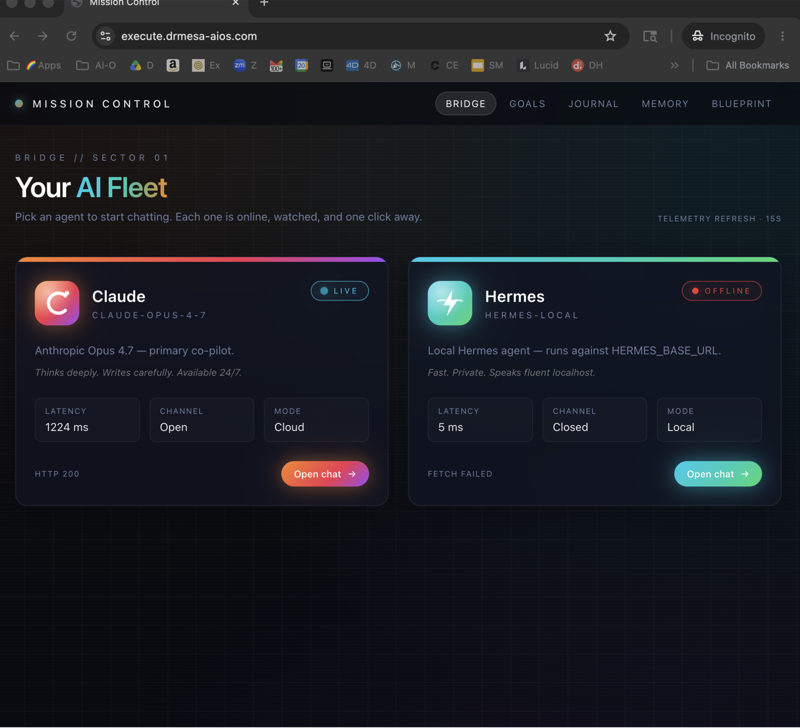
The Agent OS dashboard is what justifies the price tag the moment a client sees it. Down the left rail are their agents with live status indicators — Claude, Hermes, OpenClaw, plus any custom agent you wire in for them. The centre is the active workspace. The right rail is the brain — goals with progress bars, daily journal, memory search across thousands of notes.
Click into any agent and you open a full control room. API keys, providers, session history, skills, plugins, Kanban-style task boards, plus a built-in analytics panel showing sessions, tool calls, tokens used, models used, activity patterns and the team's actual peak hours. That's an ops dashboard most enterprise SaaS tools would charge five figures a year for, and you're delivering it as a one-off install.
Clients pay because they see the screen and immediately understand what they've been missing. The dashboard is the demo.
How I Built The Hermes Agent OS In Roughly One Hour With Claude Desktop
The build took about an hour in one Claude Desktop session. The economics are absurd — you spend an hour building it once, you sell it many times. The prompt I used is the same one you can copy directly.
I asked Claude to "create a beautiful operating system hosted locally for managing Claude for a website connected to Claude, like a beautiful mission control dashboard, and then allow me to control my OpenClaw, my Hermes, and any other agents in separate systems inside the dashboard." Then I pasted in the documentation from the Hermes GitHub and the OpenClaw GitHub so Claude understood the agent APIs.
Claude scaffolded the whole thing in Next.js and Tailwind, fully locally hosted. On first pass it had the dashboard, the chat panels, the goals tracker, the journal, the memory layer, and the per-agent control rooms working. By the end of the session I had voice input via the microphone added too. That's your client deliverable, ready to install on their hardware. One hour of build time, repeatable forever.
The Goldie Mission Stack — 4 Layers You Sell As A Package
The Goldie Mission Stack is the framework I sell against. It gives the client a clear mental model for what they're paying for. Each layer has its own deliverable.
Layer 1 — Intelligence (Claude / Claude Code)
Claude is the CEO of the client's stack. The deliverable is Claude wired into their Agent OS as a live connection with full tool access, MCPs configured, and the ability to write and execute code in their environment. Premium clients pay for this configured properly the first time.
Layer 2 — Execution (OpenClaw)
OpenClaw is the local agent gateway. The deliverable is OpenClaw installed, routing tasks between agents, managing sessions and handling multi-agent coordination across the client's stack. Without this layer, every agent project they've ever paid for has felt chaotic — and they know it.
Layer 3 — Research (Hermes)
Hermes runs the tool calls, Kanban task lists, skills, plugins, scheduled workflows and research tasks. The deliverable is Hermes installed, plugged into the client's data sources, and running the actual work. My setup guide is in Hermes Agent Installation Guide 2026.
Layer 4 — Self (Obsidian Vault + OMI)
The Self Layer is the upsell. OMI records the client's screen and microphone, exports to an Obsidian vault, and every agent pulls from that vault for personalised output. Most service providers don't even know to offer this layer. Add it and your price tag doubles. See OMI Obsidian for the install.
Why The Self Layer Is The Premium Upsell
The Self Layer is what lets you charge premium for Agent OS. It's the layer that turns a generic AI install into one that operates as if it's been at the client's business for years. Three components, each one worth selling on its own.
Goals are tracked with progress bars so every agent in the client's stack knows what the team is working towards this quarter. Journal entries — voice or text — go into the vault daily so agents always have current context. Memory means every chat is auto-saved and vault-searchable, which means the client's AI never forgets a thing about their business.
Day one is good. Day thirty is wild. The system compounds, which means the client keeps paying you for the maintenance and upgrades because they can see the system getting smarter. That's a retention play built into the deliverable.
Why Local-First Is The Right Sell For Premium Clients
Agent OS lives on the client's hardware, and that's a feature you charge for. Local-first beats cloud for premium service work for three reasons.
First, the client's data stays on their machine. Revenue numbers, client notes, founder journals, strategic plans — none of that belongs in a cloud database you don't control. Local-first is the easiest privacy and compliance sell in the market right now.
Second, it's faster. There's no round-trip latency every time the client switches agents or pulls memory. Everything runs instantly because everything sits on their hardware.
Third, the integrations are cleaner. Claude, Hermes, OpenClaw, Obsidian and OMI all talk to each other through local files and local APIs. That's a much cleaner install than juggling five different cloud platforms with five different auth flows for a paying client.
A Real Example That Sells The Install
A real example from this week, the kind you can demo to a prospect. I opened Agent OS, typed "based on my Obsidian vault, give me some ideas on what I should automate today" into Hermes, and hit enter.
Hermes pulled context from my Goldie Agency notes, my AIPB community notes, and my current Hermes build work. It came back with a personalised automation list — not generic ideas, but quick wins tied to projects already on my desk. "Quick wins for you as well — here's where automation would move the needle today" was the framing.
Imagine that demo with the prospect's own Obsidian vault loaded. They watch Hermes pull from their own notes and produce a strategic memo about their own business. That's a closed deal. Most clients have never seen anything like that.
Pricing And Packaging Agent OS As A Service
Three tiers I've tested with paying clients work well. A core install at £5K covers Agent OS scaffolded on the client's machine with Claude, Hermes and OpenClaw wired in. A full Goldie Mission Stack at £12K to £15K adds the Self Layer (OMI + Obsidian) plus 30 days of post-install support. A managed retainer at £3K to £8K per month covers ongoing builds, agent additions and Self Layer enrichment.
The maths is generous. You built the core asset once in an hour. Every install is mostly configuration and Self Layer setup. Retainers compound because each month adds more agents, more skills, more vault content. This is exactly the kind of leverage AI service businesses should be selling in 2026.
Getting Agent OS As An AIPB Bonus To Resell
If you want to skip the build and start selling, I package the whole thing as a bonus for AIPB members. You get the Agent OS zip file ready to install, 100 prompts to drive it, and a 30-day roadmap you can repurpose as a client onboarding programme.
That sits inside a stack of 27+ launch kits — Hermes Agent + Claude OS launch kit, OpenClaw Agent Revenue Team Kit, Hermes Money Machine, Hermes 10K Blueprint, $5K Proposal Pack, HermesClaw Payday Protocol, Hermes Agent OS 10 revenue builds pack, Founders Revenue Blueprint, plus the 105 Agency-Level Money-Making Prompts. All of it is ready to use in your service stack tomorrow.
Membership is $69/month locked forever with a 7-day refund and a 30-day ROI guarantee. One client install pays for the membership for the next 80 years.
Service Comparison — One-Off Prompts Vs Agent OS Installs
| Service Capability | One-Off Prompt / GPT Sale | Agent OS Install |
|---|---|---|
| Average price | £200 to £1K | £5K to £15K |
| Memory between sessions | None | Vault-backed |
| Multi-agent coordination | None | OpenClaw routing |
| Goal tracking for client | None | Built-in |
| Voice + journal layer | None | OMI + Obsidian |
| Local-first data | Rare | Default |
| Built-in analytics | None | Sessions, tokens, peak hours |
| Retention / retainer | Hard | Natural fit |
| Compounding for client | No | Yes — day 30 is wild |
| Asset reuse for you | Low | Build once, sell many |
The right-hand column is the new service game.
🚀 Want hands-on coaching to build your own Agent OS? AIPB has 4 weekly live coaching calls with me + daily Q&A with custom video answers. → Join here
FAQ — Make Money With Hermes Agent OS
What's a realistic price for an Agent OS install?
£5K for a core install, £12K to £15K for the full Goldie Mission Stack with Self Layer, plus £3K to £8K per month retainer for ongoing builds.
How long does the build take?
About one hour in Claude Desktop for the core OS. Client installs are mostly configuration and Self Layer setup on top of the prebuilt asset.
Do I need to code to deliver this?
No. You describe what you want, paste in the Hermes and OpenClaw docs, and Claude scaffolds it in Next.js and Tailwind on first pass.
Why local-first as a service?
It's the easiest privacy and compliance sell in the market. Clients keep their data on their machine, you avoid all the cloud auth headaches.
What's the difference between Agent OS and Hermes?
Hermes is one agent inside Agent OS. Agent OS is the dashboard, memory layer and coordination shell sitting above every agent — see Agentic AI OS for the broader thesis.
How do I demo this to prospects?
Load the prospect's own Obsidian vault (or sample) and run a Hermes prompt that pulls from it. That single demo closes most calls.
What about the HUD overlay?
Pair Agent OS with the Hermes Agent HUD UI and you can upsell a desktop overlay so clients drive agents without ever opening the dashboard.
Should I upgrade to AI Profit Boardroom?
If you want the prebuilt zip file, the 100 prompts, the 30-day roadmap, the 27 other launch kits, the $5K Proposal Pack, and the weekly live coaching, yes — the twin guarantee makes it zero-risk to try.
Latest Updates
- Hermes Agent Goals (NEW Persistent Update FREE) — goal loops to upsell on top of an Agent OS install.
- Hermes Computer Use — desktop-control upsell for premium clients.
- Claude Hermes Agent — the Claude side of the Intelligence Layer.
Further Reading On Agent OS Guide
For deeper walkthroughs on the topics in this article, the Agent OS Guide library has these worth bookmarking.
- Agent OS Guide — the full library of Hermes-first agent OS walkthroughs in one place.
- Hermes Agent OS Q&A — the questions founders ask most about the Hermes stack.
- Hermes SEO Agent OS — how Hermes plugs into a real SEO workflow.
- NotebookLM Agent OS — pairing NotebookLM with the Hermes research layer.
Also On Our Network
- 🌐 Read on bestaiagentcommunity.com
- 🌐 Read on aiprofitboardroom.com
- 🌐 Read on juliangoldieaiautomation.com
- 🌐 Read on aisuccesslabjuliangoldie.com
Related Reading
- Hermes AI Agent Framework 2026 — the framework you sell with the install.
- Hermes Agent Installation Guide 2026 — install Hermes first as part of the deliverable.
- Hermes MCP Server — the server side of the premium install.
- OMI Obsidian — the Self Layer upsell in detail.
📺 Video notes + links to the tools 👉
🎥 Learn how I make these videos 👉
🆓 Get a FREE AI Course + Community + 1,000 AI Agents 👉
Hermes Agent OS is the premium service stack that turns one hour of build time into a five-figure deliverable — package the Goldie Mission Stack, sell the install, and the retainer almost sells itself.