Claude Hermes Agent is the single biggest margin upgrade I've shipped inside my 50-person SEO agency in 2026, and after running it across nine recurring agency workflows I'm convinced this is the stack every marketing agency owner should be installing this quarter. Claude does the thinking, Hermes does the doing, and the MCP bridge between them turns repetitive operator work into recurring revenue capacity.
This post is the money angle on the Claude Hermes Agent stack — the nine agency workflows I run on it daily, the cost savings versus running Claude API direct, and the ROI math that's let my agency add clients without adding headcount.
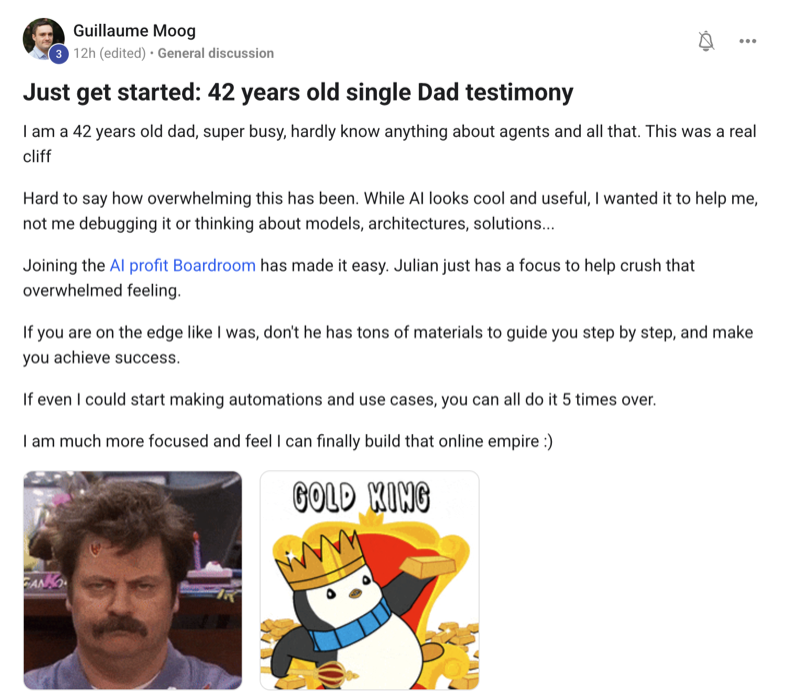
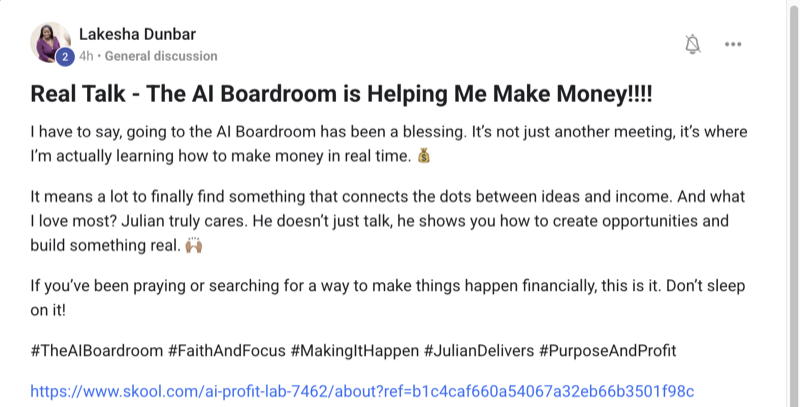
🔥 Want the full Claude+Hermes setup + 100 prompts? AI Profit Boardroom has the 30-day roadmap, full setup SOPs, custom-video daily Q&A, plus 4 weekly coaching calls with 2,900+ entrepreneurs. → Get inside
Why Marketing Agencies Should Care About Claude Hermes Agent
Marketing agencies run on operator capacity.
Every recurring client task — competitor checks, ad copy variations, monthly reports, weekly digests, outreach follow-ups — eats account-manager time that could be selling new clients or upgrading existing ones.
The Claude Hermes Agent stack moves the bottom 60% of that operator work onto AI agents that run on schedule.
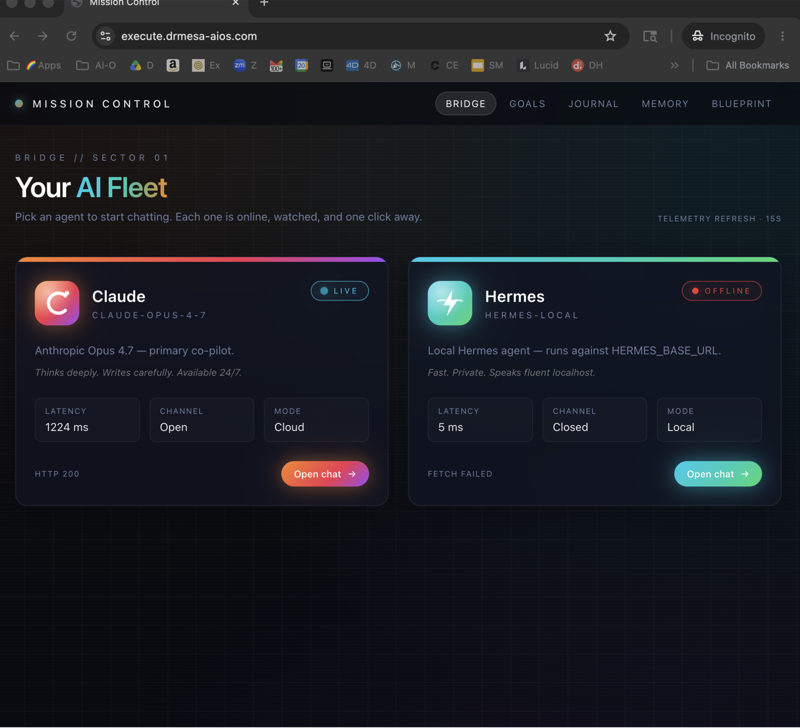
Claude is the brain that plans the work.
Hermes Agent is the hands that executes it.
The MCP bridge between them keeps the loop running 24/7 without anyone clicking buttons.
For an agency owner, that's not a productivity tool — that's a margin upgrade.
The Claude Hermes Agent Delegation Loop At Goldie Agency
I named the pattern after my own agency because we've been running it for nearly a year and it's the single biggest operational change we've made.
Layer one is the Brain.
Claude is the CEO of the stack — it plans the work, makes decisions, and writes the strategic outputs.
Layer two is the Bridge.
Hermes MCP is the connector that 99% of agency owners still don't have installed.
Layer three is the Hands.
Hermes Agent does the physical work — browses competitor sites, sends outreach emails, builds reports, schedules digests, monitors ads, manages the swipe file.
The loop runs five steps.
We speak.
Claude thinks.
Hermes acts.
Results come back.
We delegate the next task.
That loop replaces what used to be a junior account manager's full day of work.
Claude Hermes Agent Use Case 1 — Competitor Monitoring + Content Gap Analysis
The first workflow we built on the stack pays for itself within a single client.
Trigger — daily cron at 7am.
Step one — Hermes browses each tracked competitor's website for new content since yesterday.
Step two — Hermes compares published keywords against our client's keyword tracker.
Step three — Claude identifies content gaps — topics competitors covered that we haven't.
Step four — Hermes saves the gap analysis to a doc and pings the strategy team in Slack.
Time saved per client per week — roughly 90 minutes.
Across 20 clients, that's 30 hours of recovered strategy capacity per week.
Money Use Case 2 — Outreach Automation
Outreach is the highest-leverage agency activity and the easiest to drop the ball on.
Trigger — new lead added to the prospect tracker.
Step one — Claude generates a personalised first-touch email based on the lead's profile and our standard offer.
Step two — Hermes sends the email and logs the send.
Step three — Hermes schedules a 5-day follow-up cron job tied to that lead.
Step four — at day 5, if no reply is detected, Claude drafts a follow-up touch and Hermes sends.
Step five — the cadence continues at day 12 and day 21 before moving the lead to dormant.
The conversion lift on our outbound sales has been visible inside two months.
Zero account-manager time spent on follow-up reminders.
Money Use Case 3 — Content Production Pipeline
Content production is the most under-automated agency workflow I see.
Trigger — Monday 9am weekly cron.
Step one — Claude reads our keyword tracker per client and selects three target topics for the week.
Step two — Hermes runs trend research, pulls competitor articles, harvests Reddit questions, and assembles a research pack per topic.
Step three — Claude drafts a content brief per topic with title, outline, target word count, target audience, and references.
Step four — Hermes saves each brief to the appropriate writers folder and pings the team in Slack with the assignments.
This pipeline alone saved us 6 hours of weekly editorial-ops work.
Money Use Case 4 — Publish-Ready Research Packs
Some content needs deeper research than a standard brief.
Trigger — manual request from strategy team or scheduled per client per month.
Step one — Hermes runs a deep web sweep for trending angles on the target topic.
Step two — Hermes pulls competitor articles, statistics, and Reddit questions on the topic.
Step three — Hermes harvests YouTube comments and Twitter discussion on the topic.
Step four — Claude assembles everything into a publish-ready research pack with a recommended structure.
Step five — Hermes saves the pack to the client folder and notifies the writer.
This turns research from a 2-hour analyst task into a 5-minute automated assembly job.
Money Use Case 5 — Client Monthly Reports
Client reporting is the workflow that wins back the most senior time per dollar.
Trigger — 1st of every month at 9am.
Step one — Hermes pulls each client's tracked KPIs from our reporting database.
Step two — Claude analyses month-over-month performance and writes the executive summary.
Step three — Hermes formats the report using our standard client template and pulls brand assets.
Step four — Hermes generates the PDF and emails it to the client contact list with a personalised opening from the account lead.
Step five — Hermes logs delivery and schedules a 7-day follow-up to gather feedback.
Once built, every additional client costs roughly zero marginal report-prep time.
That changes the unit economics of the entire agency.
Money Use Case 6 — Friday 5pm Performance Digest
The weekly digest is a soft-power workflow that drives retention.
Trigger — every Friday at 5pm.
Step one — Hermes pulls the week's key metrics for each client.
Step two — Claude formats per-client digests with wins, losses, and next-week focus.
Step three — Hermes emails each digest to the corresponding account team.
Step four — Hermes logs the digest send to the client file.
Clients love it because their teams arrive Monday with context already loaded.
Account leads love it because they don't write the digests anymore.
Money Use Case 7 — Ad Copy Generation
Ad ops is a volume game and Claude+Hermes handles volume better than humans do.
Trigger — new ad set briefed via Slack with target audience and offer details.
Step one — Claude generates 10 ad copy variations per platform per ad set, varied across hook style, length, and CTA.
Step two — Hermes saves variations to the campaign folder organised by ad set ID.
Step three — Hermes posts a preview to the ads channel for media-buyer review.
Step four — once approved, Hermes formats the copy for upload to the ads platform.
Ten variations per ad set used to take a copywriter half a day.
Now it takes 4 minutes.
Money Use Case 8 — Competitor Ad Tracking
Competitor ad intelligence used to require a $300/month tool plus a junior analyst.
Trigger — daily cron at 8am.
Step one — Hermes checks the Facebook Ads Library for each tracked competitor.
Step two — Hermes detects new ads since yesterday and logs them to the swipe file with screenshots.
Step three — Claude classifies each new ad by angle, hook, and offer type.
Step four — Hermes drops the daily log into the strategy channel for the creative team.
The swipe file builds itself.
The creative team has fresh inspiration every morning.
The third-party tool subscription got cancelled.
Money Use Case 9 — Social Scheduling Briefs
Social media coordination is a small recurring task that drains operator time.
Trigger — every Sunday at 6pm.
Step one — Hermes pulls trending topics in our space across LinkedIn, X, and YouTube.
Step two — Claude writes a weekly content brief with platform-specific hooks per day.
Step three — Hermes assembles the brief into the social planner template.
Step four — Hermes pings the social media manager Monday morning with the upcoming week's brief.
This single workflow gave us back roughly 90 minutes of social-strategy time per week.
The Money Math For Marketing Agencies
Let me run the actual numbers for a typical 20-person agency.
Operator capacity recovered across these nine workflows — roughly 60 hours per week.
That's 1.5 FTEs of recovered capacity.
At UK loaded cost of around £45,000 per FTE that's £67,500 a year of recovered capacity.
API cost savings versus running this stack on Claude API direct — roughly £400 a month, or £4,800 a year.
Subscription cost — zero beyond your existing Claude subscription.
Total first-year ROI on a 15-minute install — roughly £72,000 of recovered capacity.
The math is silly.
Bypassing The Claude OAuth Restriction
The cost savings on this stack matter for agencies specifically.
Claude has stopped letting Hermes Agent connect via plain OAuth login.
The official path is to pay for Claude API access if you want Hermes to use Claude's brain.
API access at agency volume — running 9 daily/weekly workflows across 20 clients — runs into hundreds to thousands of pounds a month.
The MCP bridge sidesteps that completely.
Hermes runs on your existing Claude subscription.
You get the best LLM brain in the world at subscription pricing rather than API pricing.
For a 20-client agency, that single architectural decision saves four figures a month.
The 15-Minute Setup For Agency Owners
You don't need an engineer to install this.
You open Claude Desktop on your laptop.
You paste the Hermes MCP GitHub link into the chat.
You ask Claude to install the MCP server.
Claude reads the repo, configures the MCP connection, and restarts.
When Claude reopens, Hermes MCP is in your connectors panel ready to use.
Total install time on my end was 15 minutes flat.
I've watched non-technical agency owners do this live on coaching calls in 18-20 minutes.
Permissions And Safety For Client Work
Agency context demands tighter safety rails than solo founder use.
Set Hermes MCP permissions like this.
Read-only tools — research, monitoring, list-skills — "always allow."
Schedule and draft tools — make cron jobs, draft emails, build reports — "needs approval" for the first month then "always allow" once trusted with logging.
Send and destructive tools — email send, delete files, payments, anything touching client systems — "needs approval" permanently.
For client-facing automations I also log every Hermes action to a per-client audit doc so we have full replay capability if a client ever asks what happened.
This is non-negotiable for agency use.
Persistent Memory Builds Agency-Wide IP
The under-discussed agency superpower in this stack is Hermes's persistent memory.
Hermes remembers context across conversations.
It builds reusable skills as you run workflows.
Your agency's knowledge base grows automatically.
Claude can reference everything Hermes has stored when it plans new work.
That means month-six output is materially better than month-one output because the stack now knows your clients, your style, your voice, and your processes.
This is the IP that compounds inside the agency.
I pair this with OMI Obsidian for a second-brain feed that captures meetings and screen recordings into the same context pool.
Claude Alone Vs Claude+Hermes Vs Claude API Direct
| Setup | Monthly Cost At Agency Volume | Action Capability | Memory | Best For Agencies |
|---|---|---|---|---|
| Claude alone | Subscription | None — chat only | Within chat only | Strategy thinking |
| Claude + Hermes MCP | Subscription only | Full agency workflow stack | Persistent, compounds | Agency operations |
| Claude API direct | £400-£2,000+ | Yes via custom code | Whatever you build | Engineering-led shops only |
For 99% of marketing agencies the middle row is the correct answer.
🚀 Are you a marketing agency? Want SEO + AI combined? Book a free strategy session with my 7-figure SEO agency Goldie Agency (50-person team). → Book free session
Common Agency Owner Objections
Three objections come up every time I demo this to agency owners.
The first is "my team isn't technical enough to build this."
You don't need a technical team.
The owner installs the bridge in 15 minutes.
Each workflow is described to Claude in plain English and Claude builds the Hermes side.
The second is "we already have Zapier and it kind of works."
Zapier is pre-wired triggers and templates.
Claude+Hermes is natural-language reasoning that builds and adapts workflows on the fly.
These are different tools — Zapier is good for fixed pipelines, Claude+Hermes is good for the 80% of agency work that needs judgement.
The third is "what about client data security?"
Set destructive and send permissions to "needs approval" permanently.
Log every action to a per-client audit doc.
For sensitive client work, run a local model like Gemma 4 with Hermes for fully on-prem operation.
You've got more security options here than with most SaaS automation tools.
When To Skip Claude+Hermes For Agency Use
Be honest about where the stack falls short.
Highly regulated client industries — healthcare, finance, legal — need extra logging and approval layers beyond the default.
Mission-critical campaigns that can't tolerate any error should still have human-in-the-loop review at every step.
Highly bespoke client workflows that don't map to existing Hermes skills may need a custom integration.
For everything else — and "everything else" is 80% of agency operator work — this is the stack.
FAQ — Claude Hermes Agent For Marketing Agencies
How much does this actually save a 20-client agency per year?
In my own agency the recovered capacity is roughly 1.5 FTEs — call it £67,500 a year of recovered cost plus £4,800 of API savings.
Is this safe for client work?
Yes when configured correctly. Set destructive tools to "needs approval" permanently and log every action to a per-client audit doc.
Will my team need to learn to code?
No. Every workflow is described to Claude in plain English. Claude builds the Hermes side.
Can I run this for client work in regulated industries?
Yes — pair it with a local model like Gemma 4 for fully on-prem operation if needed.
How do I onboard my account managers?
Start with one workflow per AM, get it humming for two weeks, then add the next workflow. Don't try to onboard all nine at once.
Should I upgrade to AI Profit Boardroom for the full SOPs?
If you want the 30-day roadmap, 100 prompts, daily Q&A, and weekly coaching, yes. The 7-day refund makes it risk-free.
What about my existing automation stack?
Don't rip out what works. Layer Claude+Hermes on top of Zapier and your CRM. Replace pieces only when the agent stack proves itself.
Latest Updates
- Hermes Agent Goals (NEW Persistent Update FREE) — autonomous goal loops worth pairing with Claude as the brain in your agency stack.
- Sonnet 4.8 Review — the model I default to as the brain across our agency workflows.
- Hermes Agent HUD UI — the visual layer that makes your agency's workflow status legible.
Also On Our Network
- 🌐 Read on bestaiagentcommunity.com
- 🌐 Read on aiprofitboardroom.com
- 🌐 Read on juliangoldieaiautomation.com
- 🌐 Read on aisuccesslabjuliangoldie.com
Related Reading
- Hermes AI Agent Framework 2026 — the framework powering the hands layer of our agency stack.
- Hermes Agent Installation Guide 2026 — the deep-dive install walkthrough.
- Claude Code SEO Agent — Claude Code paired with SEO automation for agency client work.
- OMI Obsidian — the second-brain layer that feeds context into agency workflows.
📺 Video notes + links to the tools 👉
🎥 Learn how I make these videos 👉
🆓 Get a FREE AI Course + Community + 1,000 AI Agents 👉
If you run a marketing agency and you want the highest-leverage free margin upgrade of 2026, the Claude Hermes Agent stack is it — install the MCP bridge today, ship your first workflow tonight, and you'll be adding clients without adding headcount inside a quarter.