Agentic AI OS is not just a productivity stack — it is the cleanest way I know to package an AI service in 2026 and actually charge money for it. The new Hermes plus Grok integration unlocked a multi-modal Studio inside my OS, and that Studio now powers four different paid offers I run for clients. This post breaks down how to make money with an Agentic AI OS, what to sell, and how to deliver it without burning out.
In this post I will cover what the Studio service stack actually is, the Hermes plus Grok backbone that makes it possible, the three commands that wire it together, the four offers worth packaging today, and the delivery model that keeps the work tight.
🔥 Get the full Agentic AI OS as an AIPB bonus AI Profit Boardroom members get the Agent OS zip file, 100 prompts, 30-day roadmap, plus Hermes Agent + Claude OS launch kit. → Get inside
Why The Agentic AI OS Is The Best Offer Engine Of 2026
Every operator I know who is making real money with AI right now has done one specific thing. They stopped selling time and started selling a system that ships outputs. The Agentic AI OS is the cleanest version of that system.
A traditional AI freelancer trades hours for money. They open a chatbot, brief it, copy the output, edit it, and hand it over. The ceiling on that work is your calendar.
An Agent OS operator builds a productised service powered by a coordinated agent stack. The OS handles the production. The operator handles the strategy and the relationships. The ceiling moves from your calendar to your stack.
That is why the same skill set that earned £50 an hour in 2024 is earning £5,000 retainers in 2026.
The Agentic AI OS Studio Service Stack — High Level
The Studio service stack is the productised service I built on top of my Agentic AI OS this month. It uses the Studio section inside my Agent OS to ship multi-modal content for clients on a recurring schedule.
The high-level pitch is simple. A client signs up for a monthly retainer. They get a fixed number of finished assets per month — short-form videos, hero images, voice clips, and supporting text — all shaped around their brand because the Self layer holds their brand profile.
The Studio runs the production. The Self layer keeps the brand consistent. Hermes plus Grok handles the live research and the actual media generation. The operator briefs, reviews and approves.
That is a service that fits inside an Agent OS perfectly and is hard for a competitor without an OS to match on speed or price.
The Hermes Plus Grok Backbone
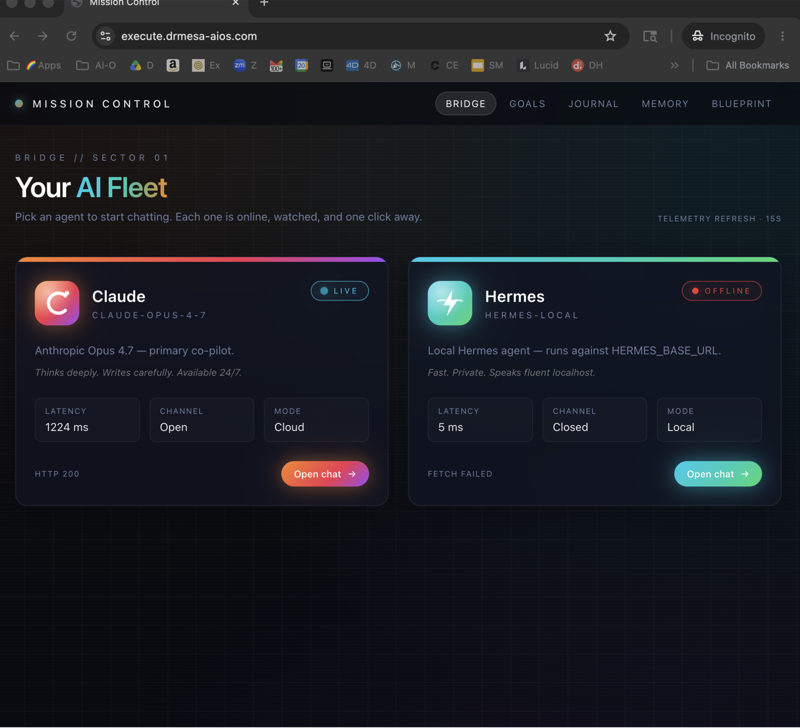
Hermes is the framework I run as the spine of my Agent OS. It hosts every other tool and exposes the dashboard.
For most of 2025 Hermes did not have native image generation, video generation, X search or voice. The Grok integration this month plugged all four in at once.
That bundle is what makes the Studio service stack possible. Without it you would still need separate subscriptions for image, video and voice tools, plus a search layer on top. With Hermes plus Grok, all four are in the same OS, on the same auth, behind the same dashboard.
For an operator, that is the difference between juggling four invoices and managing one stack.
Three Commands To Plug Grok In
The setup is short. Three commands and one browser login.
hermes update pulls the latest Hermes build with the Grok auth ready to go.
hermes model opens the model picker. Pick XAI Grok Auth and log in with your X account in the browser window that opens.
hermes tools opens the tools menu. Enable X search, image generation, video generation and text to speech. Tick all four.
Two minutes of terminal work and the Studio is live. The cost is your existing X subscription.
What The Studio Section Looks Like Inside The Agentic AI OS
The Studio is a section inside the Agent OS dashboard. I added it with a single prompt to Claude Desktop and it now sits as a permanent module.
Inside Studio I can run image, video and speech generation in parallel. One tab generates a video while another handles voice and a third produces an image. The OS saves the history so I can pull any output back later without re-running the prompt.
For client delivery, that parallelism collapses production time from hours to minutes. A monthly content batch that used to span two days now runs in an afternoon.
The Goldie Mission Stack — The Architecture Behind The Offer
The Studio service sits on top of the four-layer Goldie Mission Stack. Each layer earns its keep in the offer.
Layer one is Intelligence. Claude plus Claude Code do the planning and the writing. Every brief turns into a structured production plan here.
Layer two is Execution. OpenClaw does the clicks and keystrokes. It handles the workflow steps that need real machine actions.
Layer three is Research. Hermes plus Grok handle the live signals, the X search, the image, the video and the voice. This is where most of the visible client value gets produced.
Layer four is Self. Obsidian holds the client brand profile, the SOPs and the past deliverables. Every output that comes out of the Studio is implicitly shaped by what is in this layer.
That stack is the moat. Anyone can buy a Grok subscription. Not many people have an OS that turns Grok into a productised service.
The Self Layer Is Why The Output Sells
The Self layer is the part that separates a Studio service from a generic AI freelancer. Without it, every output sounds like every other AI output on the internet.
Obsidian holds the client brand voice, the offer descriptions, the customer avatars and the past content. OMI captures voice notes from calls and pipes them into Obsidian automatically. The OS reads all of it whenever it produces an asset for the client.
Because the OS already has the context, the operator does not need to brief every prompt. The output starts in the right tone, with the right examples and with the right structure.
That is what lets a Studio service retainer command £2,000 to £5,000 per month rather than $20 an hour on a freelance marketplace.
Four Offers Worth Packaging Right Now
The first offer is a monthly content retainer. Twelve short-form videos, twelve hero images and four long-form voice clips per month. Priced between £2,000 and £5,000 depending on the client size.
The second is a launch-week production sprint. One offer launch, everything from hero images to ad creative to a podcast voice-over, delivered in a single week. Priced as a fixed package of £3,000 to £10,000.
The third is a monthly intel report. Hermes plus Grok runs X search and trend monitoring for a niche and delivers a packaged report. Priced as a low-tier retainer of £500 to £1,500 per month.
The fourth is an Agent OS setup service. You build the OS for a client team and hand it over with a 30-day support window. Priced as a one-off of £3,000 to £15,000 depending on scope.
All four are deliverable by one operator running the OS. That is the leverage.
Watch The Walkthrough
For the underlying agent framework see my Hermes AI Agent Framework 2026 breakdown for the full picture of what sits underneath the OS.
Why Local-First Helps You Win Bigger Clients
Bigger clients ask harder privacy questions. A local-first Agent OS gives you better answers than a cloud-only stack.
Their data stays on your machine instead of training a vendor model. That sentence alone unlocks contracts in regulated industries that cloud-only freelancers cannot touch.
Your delivery is also faster because local reads and writes are instant. There is no round-trip lag in the middle of a production batch.
And you control the stack. If a model vendor changes pricing, you swap the model and the offer keeps running because the OS is yours.
Comparison Table — Freelance AI Vs Studio Service Stack
| Capability | Freelance AI Operator | Studio Service Stack |
|---|---|---|
| Pricing model | Per hour or per task | Productised retainer |
| Memory of client brand | None | Obsidian vault per client |
| Multi-modal output | Per-tool subscriptions | One Grok subscription |
| Production speed | Sequential | Parallel inside Studio |
| Margin | Low after tool costs | High after one-time OS setup |
| Differentiation | Hard to defend | Stack moat |
| Capacity ceiling | Your calendar | Your OS |
| Sample retainer size | £300-£800 | £2,000-£5,000 |
That table is the case for why I do not take per-hour gigs anymore.
🚀 Need an AI agent stack for your agency? Book a free SEO + AI Strategy Session with Goldie Agency. → Book free session
How To Find The First Three Clients
The first place to look is your existing network. Anyone running a business who posts content needs more of it and better of it. Open a Loom of the Studio in action and pitch a one-month trial.
The second place is X and LinkedIn. Post a finished asset from your Studio, tag the niche you serve, and offer a discovery call. Live proof beats long sales copy.
The third place is communities like AIPB. Operators in the community refer clients to each other constantly because the work is too big to handle solo.
Aim for a first cohort of three clients on a one-month trial. Use the trial to refine your Studio. Convert the strongest two into retainers and refer the third out.
Delivery Without Burnout
The mistake most operators make is treating a Studio service like manual work. It is not. The OS does the production. You handle the strategy and the relationship.
A clean delivery week looks like this. Monday is brief intake and Studio queue prep. Tuesday and Wednesday are production runs inside Studio. Thursday is review and revisions. Friday is delivery and the next week's plan.
You should never be doing manual production for more than two days a week per client. If you are, your Studio is misconfigured.
Pricing Without Apologising
A productised Studio service is not an hourly job and should not be priced like one. Pick a monthly retainer that reflects the value of the assets you produce, not the time you spend.
Twelve finished short-form videos per month is worth thousands to most clients. They are not paying for the time. They are paying for the consistent output and the brand fit.
The Self layer is the reason you can charge premium. Generic AI outputs cost zero. Brand-fit outputs that ship on a schedule are worth a multiple of that.
FAQs
How fast can a beginner build a Studio service?
If you follow the launch kit, the OS plus a basic Studio service can be live in a week. The first client comes from your network.
Do I need to be on camera to sell this?
No. Most of the work is back-end production. You only need to be on camera if your offer is creator-led.
What if a client wants edits?
Build a one-revision policy into the retainer. Edits inside Studio are fast because the assets and history are all saved.
Can I run more than one Studio service at once?
Yes. The OS supports multiple client vaults in Obsidian, so each Studio is shaped around its own brand without bleed.
Is the launch kit worth joining AIPB for?
If you want the pre-built Agent OS zip, the 100 prompts and the 30-day roadmap that turns the stack into an offer, yes. The weekly coaching is where the offer feedback happens.
When A Studio Service Is The Wrong Offer
If you are not comfortable with creative production or with client management, this offer is the wrong fit. It is a service business and it requires both.
If you only want passive income, this is not it. The Studio reduces production time enormously but it still needs an operator.
If your local market does not have clients who pay for content, target globally. The OS is location-independent.
When A Studio Service Is The Right Offer
If you have a content background and want to charge for outputs instead of hours, this is the cleanest path I have seen.
If you already run an agency, adding a Studio retainer tier turns the OS into a revenue line your competitors cannot match on price.
If you want to ship one offer that scales without hiring, this is the one that fits the constraint.
FAQ — Make Money With Agentic AI OS
How much can I realistically earn in month one?
One trial client at £1,000 to £2,000 is realistic if you have a small network. Two to three by month three is realistic with consistent posting.
How many clients can one operator handle?
Five to ten retainer clients comfortably if the OS is dialled in. Beyond that you start hiring or productising further.
Do I need a contract template?
Yes. A simple monthly retainer agreement covering scope, revisions and termination is enough to start. AIPB has templates in the launch kit.
How do I avoid scope creep?
Fix the deliverable list at the start of each retainer. The OS makes it easy to over-deliver if you let it. Keep the scope tight.
Can I run this stack in parallel with a day job?
Yes. The OS automates enough of the production that one or two clients can run alongside a day job without losing your weekends.
Latest Updates
- Hermes Agent HUD UI — the dashboard that hosts the Studio section.
- Claude Hermes Agent — the Claude plus Hermes pairing at the heart of the Intelligence layer.
- OMI Obsidian — the wearable plus vault combo that powers the Self layer.
Further Reading On Agent OS Guide
For deeper walkthroughs on the topics in this article, the Agent OS Guide library has these worth bookmarking.
- Agent OS Guide — the full library of agent OS walkthroughs and reference builds.
- Hermes Agent OS Q&A — the most-asked questions about running an agent OS day to day.
- NotebookLM Agent OS — how the research layer slots into the wider stack.
- Agent OS Member Testimonials — real operators on what the OS pattern changed for them.
Also On Our Network
- 🌐 Read on bestaiagentcommunity.com
- 🌐 Read on aiprofitboardroom.com
- 🌐 Read on juliangoldieaiautomation.com
- 🌐 Read on aisuccesslabjuliangoldie.com
Related Reading
- Hermes Agent OS — the full Agent OS breakdown that this post builds on.
- Hermes AI Agent Framework 2026 — the framework powering the Research layer.
- Hermes Agent Installation Guide 2026 — the install path to follow before you sell the service.
- Hermes MCP Server — how to expose Hermes capabilities to other tools.
- Hermes Computer Use — the Execution layer that handles real clicks and keystrokes.
📺 Video notes + links to the tools 👉
🎥 Learn how I make these videos 👉
🆓 Get a FREE AI Course + Community + 1,000 AI Agents 👉
Making money with an Agentic AI OS is the highest-leverage offer move I have made in 2026 — wire Grok into Hermes, build your Studio service stack, and you will be charging retainers other operators cannot match within a quarter.