The number one question I get after people see my Agent OS setup is some version of the same thing.
"Your whole stack runs locally on your Mac Studio. So what happens when you leave the house?"
The answer is Tailscale, and it's the piece of my stack I explain the least because it just works.
Today I'm fixing that. This is exactly how Tailscale slots into an agent os, why it's the perfect match for the local-and-private philosophy, and how to set it up in about fifteen minutes.
Want my full Agent OS on your machine? The complete zip lives inside AI Profit Boardroom with 100+ prompts and the 30-day roadmap. $69/mo locked forever, twin guarantee, 5 weekly coaching calls. Get the stack
The Problem Nobody Warns You About
When you build an agent os, everything important lives on your machine.
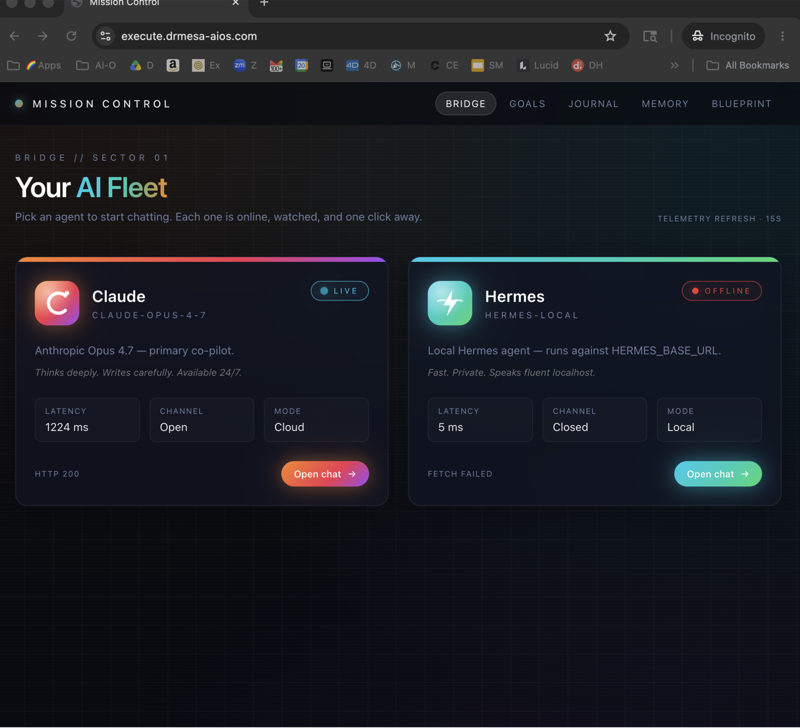
Mission Control on localhost.
Hermes running your agents.
Your Obsidian vault holding the shared brain.
Your cron jobs firing overnight builds.
That's the whole point. Local and private. Your keys, your data, your machine.
But here's the trap most people fall into.
They build this beautiful private stack, and then the first time they want to check an overnight build from a coffee shop, they punch a hole in it.
Port forwarding on the router.
A random ngrok tunnel with a public URL.
A dashboard exposed to the open internet with a prayer for a password.
Every one of those moves takes the most private part of your business and hangs it on the public internet. There's a better way, and it's boring in the best possible sense.
What Tailscale Actually Is
Tailscale is a mesh VPN built on WireGuard.
Forget everything you associate with the word VPN. This is not the thing you use to watch Netflix from another country.
Tailscale creates one private network — they call it a tailnet — that all of your devices join. Your Mac Studio. Your laptop. Your phone. A VPS if you run one.
Every device gets its own stable private IP and its own name.
From that point on, your devices talk to each other directly, encrypted end to end, no matter what wifi you're sitting on.
To the rest of the internet, nothing exists. No open ports. No public URL. No attack surface.
It's the same philosophy as the agent os itself. Private by default, yours by design.
Why Tailscale And Agent OS Are The Perfect Pair
The agent os has six pillars, and two of them are local-and-private and builds-while-you-sleep.
Tailscale is what makes both of them real instead of theoretical.
1. Mission Control From Your Pocket
My Mac Studio at home is the mothership. Mission Control, Hermes, the whole crew runs there.
With Tailscale, I open my phone, type the Mac Studio's tailnet name plus the port, and I'm looking at my actual Mission Control dashboard.
The real one. Not a cloud sync. Not a screenshot. The live dashboard, served from my own machine, over an encrypted tunnel that nobody else can see.
Overnight build finished at 3am? I check it from bed.
Goal Mode progress while I'm at dinner? Two taps.
2. Your Agents Travel With You
An agent os without remote access is a machine you can only drive from one chair.
With Tailscale, my laptop becomes a thin client for the whole stack. I can sit anywhere in the world and drive Hermes on the Mac Studio like I'm sitting in front of it.
The heavy lifting stays on the big machine. The GPU, the models, the memory, the vault. My laptop is just a window.
This is the part that makes builds-while-you-sleep actually useful, because the results reach you wherever you are.
3. One Private Network For The Whole Crew
If you run agents across more than one machine — a Mac at home, a VPS for long-running jobs, maybe a second box for builds — Tailscale turns them into one team.
Every machine on the tailnet can reach every other machine by name.
Your agent on the VPS writes to the vault on the Mac Studio. Your orchestrator dispatches to workers on both. The machines behave like they're sitting on the same desk, even when they're on different continents.
4. Tailscale SSH Kills Password Chaos
Tailscale has a built-in SSH feature that uses your tailnet identity instead of passwords and key files scattered everywhere.
For agent ops this is gold. Your automation can hop between machines on the tailnet with proper identity-based access, and you never manage a single credential file by hand.
5. Serve And Funnel, Used Correctly
Two Tailscale features people constantly confuse.
Tailscale Serve exposes a local service to your tailnet only, with proper HTTPS. This is what you want 95% of the time. Your dashboard, your API, your tools — reachable by your devices and nobody else.
Tailscale Funnel exposes a service to the whole public internet. That's for the rare case you genuinely want something public, like a webhook endpoint for a demo.
The rule in my stack: Serve by default. Funnel only when a stranger needs to hit it. That one rule keeps the entire agent os private.
The Setup, Start To Finish
This genuinely takes about fifteen minutes.
Step one. Install Tailscale on the machine running your agent os. On a Mac it's a download from tailscale.com or one line with Homebrew. Sign in with your Google, Microsoft or GitHub account.
Step two. Run tailscale up or open the app. Your machine joins your tailnet and gets a name like mac-studio.your-tailnet.ts.net with MagicDNS switched on.
Step three. Install Tailscale on your laptop and phone and sign into the same account. They join the same tailnet instantly.
Step four. Test it. From your phone's browser, hit http://mac-studio.your-tailnet.ts.net:9119 or whatever port your dashboard lives on. You're in.
Step five. Turn on Tailscale SSH on the machines you want to administer remotely. One flag. Done.
Step six. If you want clean HTTPS for a dashboard, use tailscale serve to proxy it over your tailnet name with a real certificate.
No router config. No dynamic DNS. No firewall rules. That's the whole job.
The free personal plan covers up to 100 devices, which is more than any home lab will ever need.
Locking It Down With ACLs
Once the basics work, Tailscale's access controls let you be precise about who and what can reach each machine.
This matters more than people think when agents enter the picture.
Say you spin up a cheap VPS to run an experimental agent. That agent does not need access to your whole tailnet. With ACLs you can give it access to exactly one service on exactly one machine and nothing else.
Least privilege, applied to your own infrastructure. The same discipline you'd want an agent to follow with your Gmail and your CRM, applied to the network itself.
What This Looks Like Day To Day
Morning, Bangkok time. I wake up and the overnight jobs have run on the Mac Studio.
I check Mission Control from my phone over Tailscale before I get out of bed.
At the coworking space, my laptop drives Hermes on the home machine like it's local. Research agent runs, I review the output, I queue the next goal.
If something needs a restart at home, Tailscale SSH from wherever I am. Thirty seconds.
At night, I queue tomorrow's builds and close the laptop. The crew works while I sleep, and the loop starts again.
None of that touches the public internet. The whole loop happens inside my own private network.
The Mistakes To Avoid
Don't port-forward your dashboards. It's the most common move and the worst one. One misconfigured service and your agent stack — which has your API keys, your vault, your business — is indexed by scanners within hours.
Don't use Funnel for private tools. If only you and your devices need it, it belongs on Serve or just the tailnet IP. Public exposure should be a deliberate decision, not a default.
Don't skip the phone. The single biggest quality-of-life win in this whole setup is checking your crew from your pocket. Set it up on day one.
Don't put every machine on full access. Use ACLs once you have more than two or three machines, especially anything running experimental agents.
The Bigger Point
People ask me why I bother running all of this locally when cloud tools exist.
The answer is compounding. Every piece of my agent os — the memory, the agents, the workflows — gets more valuable the longer it runs, and none of that value leaks to a platform I don't control.
Tailscale is what makes that philosophy practical. Local doesn't have to mean stuck at one desk. Private doesn't have to mean inconvenient.
You get the sovereignty of running your own stack and the reach of the cloud at the same time.
That's the whole game.
I help business owners scale with AI agents, automation, and the agent os stack I run on my own machine every day.
Get my best AI training inside the AI Profit Boardroom
Further Reading On Agent OS Guide
For deeper walkthroughs on the topics in this article, the Agent OS Guide library has these worth bookmarking.
- Agent OS Guide — the full library of agent OS walkthroughs and reference builds.
- Hermes Agent OS Q&A — the most-asked questions about running an agent OS day to day.
- Agent OS Member Testimonials — real operators on what the OS pattern changed for them.
Related reading
- Inside My Agent OS — The Full Stack Walkthrough — the panel-by-panel tour of the stack Tailscale connects to.
- Hermes Agent OS — the research-and-build agent at the centre of the crew.
- Hermes Agent Mission Control — the dashboard you'll be opening from your phone.
- Claude Obsidian Setup — the shared brain your agents read and write.
That's Tailscale plus agent os — the missing piece that makes a private stack reachable.