A DeepSeek harness agent is what you get when you wrap DeepSeek's new harness around an AI model: a brain plus a body, which means a worker rather than a chatbot. The model supplies the thinking. The harness supplies the hands, the memory, the workspace and the rules about what it is allowed to touch. Put the two together and you have an agent that reads your files, writes your drafts and gets real jobs done while you are at the gym.
📺 Watch: DeepSeek Harness: FREE 1 Hour Course!
🔥 Get the Agent OS as a free bonus: AI Profit Boardroom members get the full Agent OS zip, prompt libraries, daily tutorials and weekly live coaching calls. → Get inside
DeepSeek published its harness on 13 August 2026 — free, open source, MIT-licensed and now past 115,000 GitHub stars — as a direct alternative to the closed ecosystem. I have covered the launch itself in my DeepSeek harness overview, so this page is about the idea underneath it: what a harness agent actually is, how you assemble one, and why the agent, not the model, is the unit that deserves your attention.
This is the core idea my whole masterclass hangs on, so let me give it to you the way I teach it.
A Brain In A Jar: What A Model Is Without A Harness
An AI model is a brain. Just a brain. It can think, and it thinks well, but it cannot touch anything. It cannot open your files. It cannot remember last Tuesday. It cannot use a browser and it cannot save its work. On its own, a model is a very smart voice in a jar.
The harness is everything wrapped around that brain: the hands, the memory, the workspace, and the rules about what it is allowed to touch. When people say AI agent, this pairing is what they actually mean. Model plus harness. Brain plus body.
You have already met harnesses even if you have never used the word. Claude Code is a harness around Claude. Hermes is a harness around any model you plug into it. DeepSeek's harness is the same species of thing, except it turned up free and open, which is exactly why so many people are now building agents on it.
Why The Harness Now Matters More Than The Brain
Here is the bit most people underrate. A top model might be 5 to 10 percent better than the next one down. A good harness, though, makes the same model dramatically more useful, because the harness decides three things: what the model can see, what it can do, and how it recovers when something goes wrong.
The industry spent two years obsessing over brains. It has now moved to bodies. That is the real story behind DeepSeek's launch: not another model announcement, but a serious open harness that anyone can build an agent on without asking permission or paying a subscription.
Want the full build, not just the concept? Inside AI Profit Boardroom I run the complete DeepSeek Harness Masterclass — the exact brain-plus-body setup from this page — alongside my Agent OS training for turning one agent into a whole team. Join AI Profit Boardroom here.
How To Assemble A DeepSeek Harness Agent
Getting the harness onto your machine takes a few minutes; my DeepSeek harness install guide walks through it, and minimal mode is the stripped-back way in if you want the lightest start. From there, building the agent comes down to three moves.
Give it a workspace. The workspace is the room your agent works in: one clean folder. Inside that folder it can read files, create files and change files. Outside that folder it cannot touch a thing. That boundary is what makes the arrangement safe enough for real work, and one clean folder per job keeps everything tidy and reviewable.
Brief it in plain English. Talk to the agent the way you would brief a smart new assistant on their first day. I use a three-part pattern: what to look at, what to produce, and what rules to follow. There is no secret syntax. If your instructions would confuse a human assistant, they will confuse the agent too.
Give it real jobs from day one. Not vibe-coded snake games — your actual daily work: content, SEO, research, whatever fills your afternoons. My rule is one automation per week. List the things you do every day, pick the easiest one you have not yet automated, and hand it over.
What The Agent Actually Does In Practice
The concept clicks the first time you watch a DeepSeek harness agent handle a proper long-horizon task. It does not answer and stop the way a chatbot does. It thinks, lists the files in the folder, opens them one by one, works through the content, and writes new files into your workspace — drafts, summaries, rewrites, whatever the brief asked for. You come back from the gym and the work is sitting there.
Mine earns its keep on words and research, because that is my business. If your work is code rather than content, the same agent pattern holds; my DeepSeek code harness guide covers that side of the street separately, so I will not duplicate it here.
📺 Watch: DeepSeek Harness VS Claude Code
Trusting The Agent: Mistakes, Trajectories And Logs
Let me be completely straight with you. AI agents make mistakes. All of them. They break, they get misled, they get distracted halfway through a job. The difference between an agent you can trust with real work and one you cannot is not that the first never errs. It is whether you can see why a mistake happened.
This is where the harness earns its keep. The trajectory view shows every step of a session: the system prompt, the context it loaded, its reasoning in full, every tool call, the exact commands it ran, the results, the timing and the turns. When a job goes sideways, you scroll to the exact step where it went wrong and fix that one thing, rather than binning the lot and starting again.
Session logs export as a zip too, which means you can check the work without redoing it. It is the same relationship a manager has with a report: you review it, you do not rewrite it.
The Interop Bridge: One Brief For Every Agent
Now for the line that matters more than the launch itself. DeepSeek's harness supports MCP, which is best understood as a standard plug socket for tools, plus the agent client protocol, and it reads agents md and claude md instruction files. Those are the same briefing files Claude Code, OpenClaw and Hermes already read.
Think about what that means. You spend twenty minutes writing one instruction file about your business — your voice, your rules, your standards — and every agent that opens the folder arrives pre-briefed. Not just this harness. Every agent. That single file is the bridge from owning an agent to running agents as a system.
📺 Watch: DeepSeek's New AI Harness Changes Everything
From One Agent To A System
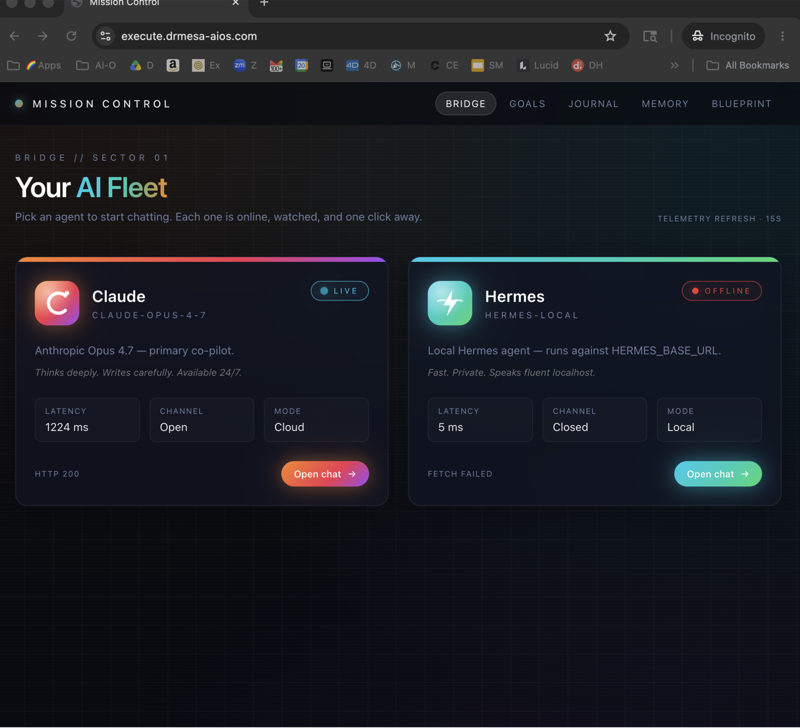
Once briefing is portable, you stop hunting for a favourite tool and start building one Agent OS: several agents sharing one memory and one mission control dashboard. My memory layer is shared Obsidian memory — plain text notes that every agent reads and writes, so when one agent learns something, every agent knows it. It is the same principle behind my Hermes memory OS setup, and my vault keeps it simple: daily, projects, research and outputs, with the agents file at the top.
People keep asking me to crown a winner among the harnesses, and I have compared the DeepSeek harness against Hermes head to head elsewhere. My working position has not changed: the agent is the unit, the system is the asset. Harnesses and brains churn. The owned system absorbs them all — I swap brains in and out as my Goldie Bench testing dictates, and the system barely notices.
The Parts Of A Harness Agent At A Glance
| Agent part | What it provides |
|---|---|
| The model | The brain: thinking and reasoning, but no hands, no memory, no files |
| The harness | The body: tools, permissions and recovery when something goes wrong |
| The workspace | The room it works in — one folder it can read, create and change files inside |
| The brief | Plain English instructions: what to look at, what to produce, what rules to follow |
| The trajectory view | Every step on the record, from system prompt to tool calls, results and timing |
| Session logs | A zip export you review like a manager checking a report |
| Instruction files | agents md and claude md briefings that any compatible agent reads on arrival |
| Shared memory | Plain text notes in Obsidian — one agent learns, every agent knows |
Harness Agent FAQs
What is a harness agent in plain English?
It is an AI model with a body. The model thinks; the harness around it provides file access, memory, a workspace and rules. A DeepSeek harness agent is simply that pairing built with DeepSeek's free harness, pointed at a folder of your real work.
Is the DeepSeek harness free?
Yes. It was published on 13 August 2026 as free, open source software under an MIT licence, and it has passed 115,000 stars on GitHub. There is no subscription gate between you and building an agent with it.
Does it replace Hermes?
Honestly, no — and I say that as someone who uses both. Hermes is a harness around any model you plug in; DeepSeek's harness is another body on the same shelf. Plenty of people run DeepSeek models inside Hermes, which I cover in my Hermes agent with DeepSeek guide, and because both read the same instruction files, choosing one is not a marriage.
How do I learn to trust it with real work?
Start with one workspace, one real job and the trajectory view open. Expect mistakes, find the step that caused them, fix that one thing, and review the session logs like a manager rather than redoing the work yourself. Trust is built from visibility, not hope.
My Verdict On The DeepSeek Harness Agent
A model on its own is a very smart voice in a jar. The harness gives it a body, and the pairing gives you a worker. Because DeepSeek's harness is free, open and compatible with the briefing files every other serious agent reads, the sensible move is not to debate it but to give a DeepSeek harness agent one folder, one plain-English brief and one real job this week, then let the results argue for themselves. The agent is the unit. The system you build around it is the asset.
Ready to build yours properly? The DeepSeek Harness Masterclass inside AI Profit Boardroom takes you from install to a working agent, then plugs it into the full Agent OS: shared memory, mission control and one real automation shipped every week alongside the community. Join AI Profit Boardroom.