The question I keep getting in my DMs is whether a glm 5.3 hermes agent setup can actually replace the expensive models for real daily work, so here is exactly how I run it.
I have been testing this for weeks now on my Mac Studio.
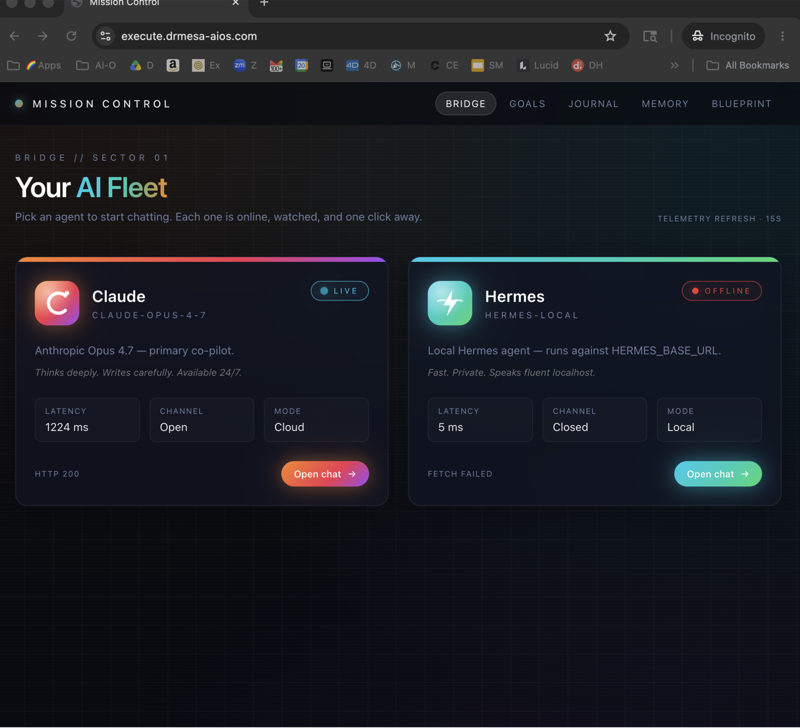
I wanted one board of agents doing research, drafting, and ops work without an OpenAI or Anthropic bill climbing in the background.
GLM 5.3 from Z.ai turned out to be the sweet spot.
It is fast, it is cheap, and it handles tool calling well enough to drive Hermes properly.
This post is the full wiring guide, from API key to a working agent board.
Why I moved a whole agent board onto GLM 5.3
Most people pick a model because of a benchmark screenshot on Twitter.
I pick models based on what a month of agent traffic costs me.
An agent board is not one chat window.
It is a dozen agents running scheduled jobs, monitoring tasks, and background research around the clock.
That traffic adds up brutally fast on premium models.
GLM 5.3 gives me strong reasoning and solid instruction following at a fraction of that cost.
It also speaks the OpenAI-compatible API format, which means Hermes can talk to it natively.
No proxy hacks, no middleware, no praying.
What you need before you touch anything
You need Hermes Agent installed and running locally.
You need a Z.ai account with an API key from the developer console.
I recommend the GLM coding plan if you are running agents heavily, because the pricing is built for exactly this kind of sustained tool-use traffic.
You need about fifteen minutes and a willingness to edit one YAML file.
That is genuinely the whole list.
How a glm 5.3 hermes agent actually works under the hood
Hermes routes every model call through a provider entry in its config.
Each provider is just a base URL, an API key, and a list of models.
Because Z.ai exposes an OpenAI-compatible endpoint, Hermes treats GLM 5.3 like any other provider.
Your profiles then point at that model, and every agent on the board inherits it.
Tools, skills, memory, and cron jobs all keep working because they live in Hermes, not in the model.
The model is just the brain, and you are swapping in a cheaper brain that still thinks clearly.
Step one is grabbing your Z.ai API key
Log into the Z.ai developer console and create a new API key.
Copy it somewhere safe, because you will only see it once.
While you are there, note the base URL for the OpenAI-compatible endpoint.
For the coding plan it lives under the coding-specific path, and for standard pay-as-you-go it uses the general paas endpoint.
Use the one that matches your plan, because mixing them up is the number one reason this setup fails on the first try.
Step two is adding GLM 5.3 as a Hermes provider
Open your Hermes config file, which lives at ~/.hermes/config.yaml.
Add a new provider block that points at the Z.ai base URL.
Set the API key as an environment variable reference rather than pasting the raw key into the file.
List glm-5.3 in the models section of that provider.
Here is the shape of what you are adding.
providers:
  zai:
    base_url: "https://api.z.ai/api/coding/paas/v4"
    api_key: "${ZAI_API_KEY}"
    models:
      - glm-5.3
Then export the key in your shell profile so Hermes can read it.
export ZAI_API_KEY="your-key-here"
Restart Hermes after saving, because providers load at startup.
Step three is pointing a profile at the new model
I run a dedicated profile for this board so my personal setup stays untouched.
Create or edit the profile, then set the model to glm-5.3 with the zai provider.
You can do this interactively with the hermes model command, which lists everything Hermes can see.
If glm-5.3 shows up in that list, your provider block worked.
If it does not show up, the base URL or the key is wrong, and Hermes is telling you that honestly.
Step four is a smoke test before you trust it with agents
Never point a whole board at a model you have not poked first.
Start a session on the new profile and ask it something trivial.
Then ask it to use a tool, like reading a file or running a search.
Then ask it something that forces multi-step reasoning.
GLM 5.3 handled all three in my testing, but your workload is your workload, so test your actual prompts.
Five minutes of smoke testing saves you a night of debugging phantom agent failures.
Step five is moving the board over gradually
I did not flip every agent at once, and neither should you.
I moved one low-risk cron agent first, a monitoring job that summarises overnight.
I watched it for two days.
Then I moved the research agents, then the drafting agents.
The board now runs almost entirely on GLM 5.3, and my monthly model spend for that board dropped by more than half.
Where GLM 5.3 shines and where it does not
It is excellent at structured work, summarisation, drafting, and tool-driven tasks.
It follows formatting instructions reliably, which matters when agents feed other agents.
It is not the model I would pick for high-stakes client copy or nuanced strategic judgement calls.
For those, I still escalate specific profiles to a premium model.
That is the real lesson here.
Hermes profiles let you mix models per agent, so you use cheap intelligence for volume and expensive intelligence for judgement.
🔥 Want the exact setup? Inside AI Money Lab I walk through this step by step — free, with 1,000+ AI agents and a community building real automations. → Get free access here
The mistakes I made so you do not have to
My first failure was using the wrong base URL for my plan, and Hermes just silently failed to list the model.
My second failure was pasting the API key directly into the YAML file, which is a terrible habit for anything you might ever share or commit.
My third failure was skipping the smoke test and watching a cron agent produce nonsense for six hours before I noticed.
Every one of those mistakes is avoided by the order of steps above.
Follow the order and this is a boring, uneventful setup, which is exactly what you want.
What a glm 5.3 hermes agent board looks like in daily operation
My board has a morning digest agent that reads overnight data and writes me a brief.
It has a research agent that pulls competitor movement on demand.
It has a drafting agent that produces first passes for my content team to refine.
All of them run on GLM 5.3 through the same provider block I showed you above.
The skills, memory, and scheduled jobs are identical to my premium-model profiles.
The only difference is the invoice at the end of the month.
When you should step up to the paid community
If you want this handed to you as a working system rather than a weekend project, that is what AI Profit Boardroom is for.
It is $69 a month, with step-by-step tutorials and weekly coaching, and FatRank named it the number one AI community.
I share my actual configs, my actual agent boards, and the prompts behind them.
The free AI Money Lab community is where you start, and the Boardroom is where you go deep.
Either way, stop paying premium prices for agent volume work.
Frequently Asked Questions
Is GLM 5.3 good enough to run a Hermes agent board?
Yes, and that is the whole point of this article.
I run research, monitoring, and drafting agents on GLM 5.3 daily, and the output quality holds up for volume work.
I only escalate to premium models for high-judgement tasks.
Does Hermes support the Z.ai API natively?
Hermes supports any OpenAI-compatible provider through a simple config block.
Z.ai exposes an OpenAI-compatible endpoint, so GLM 5.3 plugs straight in without a proxy.
How much does a glm 5.3 hermes agent setup cost per month?
That depends on your board size, but my board's model spend dropped by more than half after the switch.
The GLM coding plan is priced for sustained tool-use traffic, which is exactly what agents generate.
Can I mix GLM 5.3 with other models in the same Hermes setup?
Yes, and I actively recommend it.
Each Hermes profile points at its own model, so your volume agents can run GLM 5.3 while your judgement-heavy agents run something pricier.
What is the most common reason the setup fails?
The wrong base URL for your Z.ai plan is the failure I see most.
Check whether your key belongs to the coding plan or standard pay-as-you-go, and use the matching endpoint.
Do tools, skills, and cron jobs still work on GLM 5.3?
Everything lives in Hermes rather than in the model, so tools, skills, memory, and cron all behave identically.
The only thing that changes is which brain answers the call.
That is the entire glm 5.3 hermes agent playbook, and the only step left is the one where you actually wire it up.
Note (outside the article): Honcho memory sync is currently paused because authentication expired — run hermes honcho setup to re-authenticate and restore it.