A Hermes memory provider question really comes down to where your agent's memory lives — and the honest answer is that the default Hermes ships with, plain markdown files on your own disk, is the right provider for most people most of the time. I have run Hermes with its memory in every realistic home: loose local files, a structured Obsidian vault, and a hosted cloud through a managed agent. The differences are real, but they are not mysterious — this is a decision about storage, ownership and trust, not about features. On this page I will show you what a provider actually means for Hermes, make the case for each home, and give you a four-lens comparison so you can decide in five minutes. If you want the wider tour of every memory choice, my Hermes memory options guide covers the full menu; this page settles one question only — where the memory should live.
📺 Watch: Hermes + Jarvis + Obsidian Memory is INSANE!
🔥 Get the Agent OS as a free bonus: AI Profit Boardroom members get the full Agent OS zip, prompt libraries, daily tutorials and weekly live coaching calls. → Get inside
What a Memory Provider Actually Means for Hermes
Here is the part that trips people up: a memory provider is not a product you go shopping for. Hermes keeps what it learns about you in files — plain markdown you can open in any text editor. The provider question is simply where those files live and which backend holds them: your own disk, a structured vault, or somebody else's cloud. That is the whole decision, which is why the Hermes memory provider choice is smaller than it sounds — it is a question about ground, not features. I cover how the files themselves work — what gets written, when, and why — in my Hermes memory system overview, and the related identity file has its own page in my guide to the Hermes soul file. Memory is what your agent learns; the provider is the ground it stands on.
One honest caveat before we compare homes: the exact plug-in options around Hermes move fast, and anything I pinned to a version number would be stale within weeks. Treat this page as the durable decision framework — where should memory live — and check the current Hermes docs for precisely which backends are supported the week you read this. The framework does not change; the plumbing does.
The Default Provider: Local Markdown Files
Out of the box, Hermes backs its memory with plain markdown files on your disk. That sounds unglamorous, and it is quietly the best default in the business, because it wins on all four lenses I judge memory by. Portability: the files go where you go — copy the folder to a new machine and your agent remembers everything, and a Hermes export carries memory with it, which is the backbone of my Hermes backup routine. Privacy: nothing leaves your disk unless you send it. Durability: no vendor can shut down, reprice or hold your agent's memory hostage, because there is no vendor in the loop at all. Inspectability: you can open the files and literally read what your agent believes about you — and when it has got something wrong, you correct the line and the belief is fixed.
That last point deserves a beat. Most memory you will meet elsewhere is a black box: something is stored, somewhere, and you find out what only when the agent acts on it. Files you can read are the opposite of that, and once you have edited a wrong memory by hand — deleted a stale fact, corrected a mangled name — you will not want to give that ability up.
Quick one before the rest of the comparison: I share my full Hermes setup — memory files, vault structure, backup routine, the lot — inside my free community, AI Profit Lab. If you want the working setup rather than just the theory, join us there and ask me directly.
The Vault as Provider: Pointing Memory at Obsidian
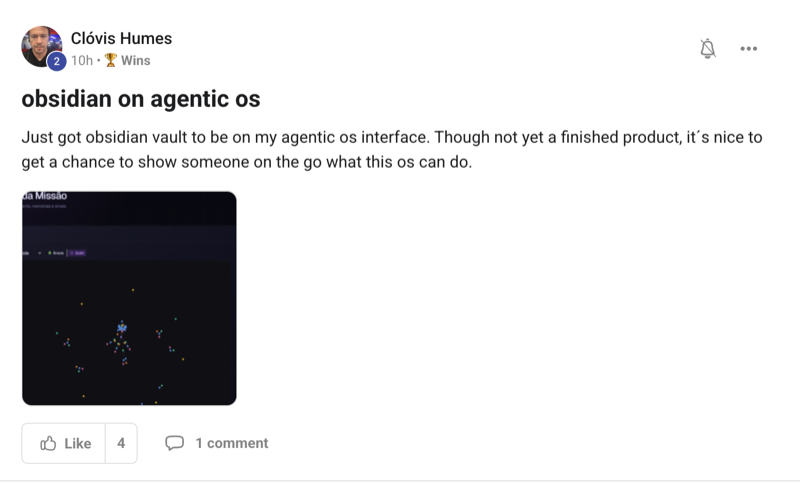
The first upgrade I recommend does not really change the provider — it gives the same provider a better home. An Obsidian vault can serve as the place your Hermes memory lives: the same markdown underneath, so every advantage from the section above survives, but you gain structure, links between notes, and the Memory Galaxy view, where the graph shows your agent's knowledge as a constellation you can actually explore. I documented that whole build, folder layout included, in my Memory Galaxy setup. If local files are the default provider, the vault is the default provider grown up: same ownership, same privacy, dramatically better visibility once the memory gets big enough that scrolling raw files stops being fun.
Hosted Memory: The Same Decision With the Signs Reversed
The genuine alternative is to let a hosted agent hold memory for you in its own cloud. The clearest example I have used is Kimi Claw, which runs OpenClaw as a hosted service with memory living in Moonshot AI's cloud — a 40GB storage tier at its beta — and I wrote up the full experience in my Kimi Claw review. I want to be fair here, because the convenience is real: nothing to install, nothing to maintain, your agent and its memory reachable from anywhere, on storage somebody else keeps healthy.
What you trade is ownership. The memory sits on someone else's infrastructure, under someone else's terms, and your access to it lasts exactly as long as the vendor does. For everyday convenience work, that can be a perfectly rational trade. For sensitive data — clients, finances, health, anything you would not email to a stranger — think very carefully before it lives in a cloud you do not control. That trade-off, convenience against ownership, is the entire provider decision in miniature.
📺 Watch: New Hermes Obsidian Memory Galaxy is INSANE!
The Fully Private Stack: Local Model, Local Memory
Push the logic to its end and you get the setup where nothing leaves the machine: a local model running through Ollama as the brain, and local files as the memory. The whole loop — thinking and remembering — happens on hardware you own, which is as private as this gets. I walk through the pairing in my guide to running Hermes with Ollama. One caution: whichever local model you choose, put it through real checks before trusting it with your memory. I run candidates through Goldie Bench, my own testing setup, before they get anywhere near my actual files — a private stack is only worth having if the model inside it is competent.
📺 Watch: Hermes3D Is INSANE: AI Agents Now Have a 3D Office
Local Files vs Vault vs Hosted: Memory Through Four Lenses
Here is the comparison I actually use when someone asks where their memory should live. Four lenses: portability (can you take it with you), privacy (who can read it), durability (what survives a vendor dying), and inspectability (can you see what it believes about you).
| Lens | Local markdown files | Obsidian vault | Hosted cloud memory |
|---|---|---|---|
| Portability | Excellent — copy the folder and go; an export carries memory with it | Excellent — still just files, with structure on top | Limited — you leave on the vendor's terms, via whatever export they offer |
| Privacy | Strong — nothing leaves your disk unless you send it | Strong — same files, same disk | Depends on the vendor — someone else's infrastructure holds what it stores |
| Durability | In your hands — as good as your backup habits | In your hands — vault syncs and backups apply | Tied to the vendor — a shutdown or a terms change is out of your control |
| Inspectability | Total — open the file, read what your agent believes | Total, plus the Memory Galaxy view to see it visually | Partial at best — you see what the interface chooses to show you |
How to Choose Your Hermes Memory Provider
My rule is short. Start with the default: local files, backed up. Add the vault on top the week your memory grows past what you will happily scroll — it costs nothing and the visibility pays daily. Reach for hosted memory only where the convenience genuinely pays: an agent you need reachable from anywhere, holding nothing you would mind a vendor being able to read. And whatever you pick, pick deliberately — memory is the layer of an Agent OS that compounds over months, so it deserves five minutes of thought now rather than a painful migration later.
Hermes Memory Provider FAQ
What is the default memory provider in Hermes?
Plain local markdown files on your own disk. They are readable, editable, portable and private, and for most people they are not just the default but the correct final answer.
Can I move Hermes memory from one provider to another?
Yes, and this is the quiet advantage of the file-based approach: because memory is files, moving it is copying. Local files into a vault is a folder move, and an export carries memory with it to a new machine. Leaving a hosted service is the harder direction — you get whatever export path the vendor offers, on their schedule.
Is hosted memory safe for sensitive information?
Treat it with real caution. Hosted memory lives on the vendor's infrastructure under the vendor's terms, so the honest question is whether you would be comfortable with that vendor holding what is stored. My own line: convenience work can live in the cloud; clients, money and health stay on my disk.
Do I need Obsidian for Hermes memory to work?
No. Hermes is fully functional with loose local files. Obsidian earns its place later, when the memory is large enough that structure and the graph view save you real time — it is an upgrade to the same provider, not a requirement.
What happens to hosted memory if the vendor shuts down?
Whatever the vendor's wind-down terms say — which is precisely the durability problem. Local files have no equivalent failure mode, because there is no company standing between you and your own disk.
Verdict: Where Hermes Memory Should Live
My answer to the Hermes memory provider question has not changed in months of daily use: file-based local memory as the base, an Obsidian vault on top for structure and visibility, and the cloud only for the specific jobs where convenience genuinely pays. That order is not ideology — it falls straight out of the four lenses, because local files win portability, privacy, durability and inspectability, and hosted memory wins only convenience. Set the provider once, deliberately, and the memory question stops being a question.
Want my exact setup? Inside AI Profit Lab I share the folder structure, the backup routine and the vault template my own Hermes memory runs on — it is free to join, and you can ask me questions directly. Bring the provider decision, leave with it made.