The best memory for hermes agent setups is not a bigger context window, a vector database or yet another plugin. According to Julian Goldie, it is a free Obsidian vault plugged into the Agent OS and visualised as the Goldie Memory Galaxy — a 3D star map where every note is a star, every link between notes draws a constellation, and the notes you touched most recently glow brightest.
📺 Watch: New Hermes Obsidian Memory Galaxy is INSANE!
🔥 Get the Agent OS as a free bonus: AI Profit Boardroom members get the full Agent OS zip, prompt libraries, daily tutorials and weekly live coaching calls. → Get inside
That sounds like eye candy. It is not. The map your eyes fly through is the exact same memory your AI reads. This guide breaks down how the galaxy works, the five layers that make it genuinely useful, and why Julian Goldie describes a plain-text vault as the layer that separates a chat window from an operating system.
The Problem: Your AI Starts Every Session Blank
Most people running AI agents hit the same four walls, usually in this order.
- Memories are scattered. Some context sits in ChatGPT, some sits in Hermes, and the two are never linked to each other.
- You forget what you saved. Notes go in, and nothing ever comes back out.
- Search has a blind spot. It only finds what you remember to look for, which is precisely the problem when you have forgotten what is in there.
- Every session starts from zero. The AI begins blank, so you re-explain your business, your clients and your preferences, over and over again.
The way most agents store memory by default is simply not efficient. Fragments live inside individual tools, locked away from one another, and none of it compounds. Julian Goldie’s fix is deliberately boring at the base and spectacular at the surface.
The Best Memory for Hermes Agent: An Obsidian Vault You Can Fly Through
The base layer is a plain-text Obsidian vault. Your agents read it before they start working and write to it after they finish. That single loop — read first, write after — is what turns a chat window into something closer to an operating system. If you want the full build, the Obsidian memory layer guide walks through it step by step.
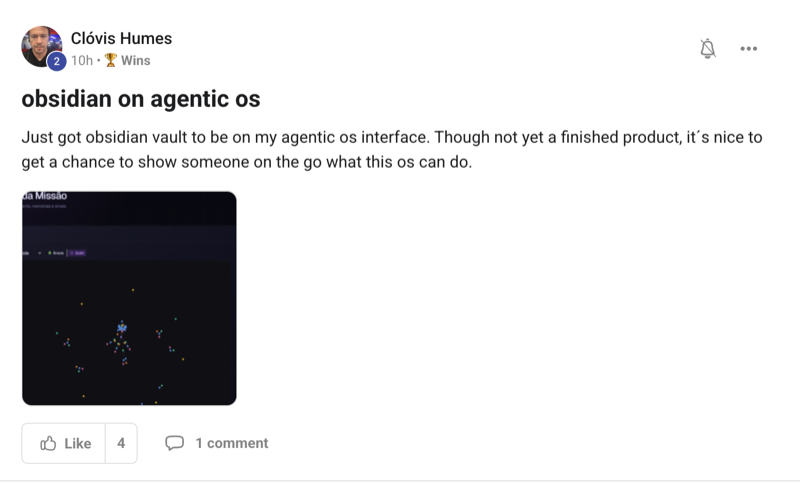
The surface layer is the Goldie Memory Galaxy. Rendered inside the Agent OS, it turns that vault into a 3D star map. Every note becomes a star. Every link between notes draws a constellation. The most recently updated notes glow brightest. You can orbit the whole thing, zoom into a cluster, and click any star to open the note behind it.
Crucially, it reads the vault as it is. No setup. No export. No reorganising weekend before you are allowed to begin. Point it at your existing notes and it renders them inside the Agent OS straight away.
📺 Watch: Hermes Agent OS Just Changed AI Agents Forever!
Old-Way Memory vs the Goldie Memory Galaxy
| Question | The old way | The Memory Galaxy way |
|---|---|---|
| Where do memories live? | Scattered across ChatGPT, Hermes and random documents, never linked | One plain-text Obsidian vault every agent reads |
| How do you find things? | Search, which only finds what you remember to look for | Recall by sight — orbit, zoom, click a star |
| How does a session start? | Blank, so you re-explain yourself constantly | Agents read the vault before they start working |
| Who writes the notes? | You, manually, whenever you remember to | Your agents, after every conversation |
| What is current right now? | No idea what you saved last week | Recent notes glow brightest, so your "now" surfaces itself |
| Setup required? | Exports, migrations, reorganising | None — it reads the vault exactly as it is |
📺 Watch: Hermes Agent V0.20 Just Changed AI Agents Forever!
The Five Layers of the Memory Galaxy
Julian Goldie breaks the galaxy into five layers, and each one solves a specific piece of the memory problem.
Layer 1: Stars
Every note in the vault becomes a point of light. The immediate win is psychological: your knowledge stops being an invisible pile of files and becomes visible at a glance. You can literally see how much you know.
Layer 2: Constellations
Links between notes draw lines, and connected ideas form constellations. Clusters reveal your real focus areas — not the ones you claim, the ones your notes prove. Dense clusters show where your thinking actually lives.
Layer 3: Glow
The most recently updated notes burn brightest, so your current work surfaces itself without you searching for it. Open the galaxy and this week’s notes are the first thing your eye lands on.
Layer 4: Fly-through
You navigate memory like a map. Orbit, zoom, dive into a cluster, click a star to open the note. That changes recall from search — which needs you to remember the right keyword — to sight, which only needs you to look.
Layer 5: Improvements
The galaxy is a feedback loop. Every note you add makes it richer, and every note your agents add makes it richer too. It becomes more useful the more you and your AI use it, which is the opposite of most productivity systems.
📺 Watch: Run Hermes Agent Free Forever, Here's how...!
Your Agents Read It, and They Write It
Here is the part most people miss: Julian Goldie does not write markdown himself. His agents do.
Every conversation with Hermes, Claude or Antigravity adds notes to the vault. Omi, which takes daily notes on him, exports those notes into Obsidian as well. The recent section updates in real time, which means the glow layer is always honest about what happened today.
The payoff shows up the moment you query it. Ask Hermes "give me keyword ideas based on my Obsidian memory" and it answers from your actual history rather than generic guesses. Ask "what did I do last month" and it comes back with specifics and dates, not a vague summary.
One distinction worth keeping straight: memory is what your agent knows, while SOUL.md is who your agent is. The soul file sets identity and behaviour; the vault supplies the lived context. A Hermes agent with both stops feeling like a tool and starts feeling like a colleague.
What a Real Memory Layer Unlocks
Once the vault is in place, four things change.
- Real context instead of generic fluff. Agents answer with your actual clients, your tone of voice and your businesses, because they read the vault before working.
- Your true focus areas, revealed. The biggest clusters in the galaxy show where your attention genuinely goes.
- Hidden connections. Constellations expose links between ideas you never consciously connected.
- Client-facing wow. You can even show a client their own project folder as a galaxy — their work, rendered as a star map.
This is also where Goldie Bench comes in. It is Julian Goldie’s own hands-on testing of agent setups — his personal scorecard, not an objective industry benchmark — and the pattern he reports there is consistent: the same agent with vault access answers with real context, while the blank-slate version produces generic output he has to rewrite. In his testing, memory beats model-hopping every time.
If you want a Hermes agent that never forgets and makes you money, check out the AI Profit Boardroom — the full Agent OS with the Memory Galaxy ships inside, as a zip plus a video tutorial, updated daily. → Give Hermes a memory that compounds
Frequently Asked Questions
My notes are a mess. Will this still work?
Yes. The galaxy does not care about your folder structure. In fact, messy clusters are often where the best ideas hide — the visualisation surfaces relationships your filing system never captured.
Is the galaxy just a gimmick?
It would be, if the pretty map and the real memory were separate things. They are not. The same map your eyes fly through is the memory your AI reads. The visual is simply a human-friendly window onto the exact files Hermes uses for context.
Do I need to organise my vault first?
No. There is no setup and no export — it reads the vault as it is. Waiting until your notes are "ready" is the one guaranteed way to never start.
What if I do not have enough notes yet?
Start small. The galaxy grows with you, and — more importantly — your agents write notes for you from day one. Give it days, not months, and it transforms.
What does it cost?
Obsidian is free and open source. Hermes is free. The setup itself is free. The full galaxy visualisation ships inside Julian Goldie’s Agent OS, which comes as a zip plus a video tutorial inside the AI Profit Boardroom and is updated daily.
How is this different from my agent’s built-in memory?
Built-in memory is fragmented and opaque: you cannot see it, browse it or hand it to another agent, and how most agents store memory by default is not efficient. A plain-text vault is portable, inspectable and shared. Every agent you run — Hermes, Claude, Antigravity — reads and writes the same brain.
The Bottom Line
The best memory for a Hermes agent is not exotic. It is a free Obsidian vault your agents read before working and write to after finishing, made visible as the Goldie Memory Galaxy: stars for notes, constellations for links, glow for recency, a map you can fly through, and a feedback loop that improves with every note you or your agents add.
Stop re-explaining yourself to software with amnesia. Give your agent a real memory, and it will give you back context, connections and answers with dates on them.