A Hermes dashboard command is a spoken or typed instruction that makes your Hermes agent build, recall, show or open something — and this is the fastest explanation of it I can write.
Short version: you talk to a dashboard, it builds real working things, and everything it builds stays there for later.
Everything else on this page is detail you can read after you've got it running.
The 60-second version
You install Hermes agent and point a dashboard at it.
You add ElevenLabs so it speaks back to you.
You set a wake word, and mine are "Jarvis" and "Hermes".
Then you say something like "build me a galaxy I can swirl with my mouse" and it comes back with "built and running, sir" and a working 3D galaxy.
Everything it makes lands in the builds section, so nothing you create disappears when you close the tab.
That's the entire concept.
The three-part stack
| Part | What it is | Job |
|---|---|---|
| Hermes agent | Open source agent project | Runs the command, builds the files, uses the browser |
| ElevenLabs | Voice API | Speaks the response back to you |
| Claude | Assistant model | Builds and improves the system in the background |
That's it, and I'd rather tell you that plainly than dress it up.
If you want to build this yourself, combine Hermes with ElevenLabs and get Claude to help you in the background.
🔥 Want the exact setup I used to get these results? Inside the AI Profit Boardroom, I've got a full Agent OS section with a complete video tutorial for the Hermes dashboard, the install zip with prompts, and daily updates. Plus weekly coaching calls + 2,800+ members building real automations. → Get access here
The six commands worth learning first
"Build me a [thing] I can [do something with]."
This is the money command, and the second half is what makes it good.
"What have I been working on this week?"
This reads your logs, so it only works once your memory link is connected.
"Show me my numbers."
Opens the metrics panel.
"Show me my team."
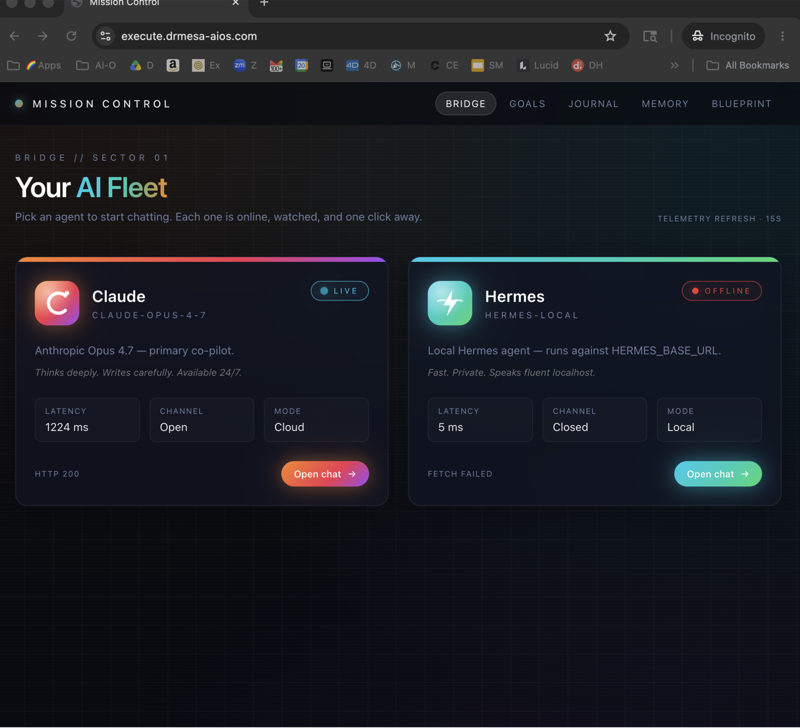
Lists every agent configured in your system — mine shows Claude, OpenClaw and Hermes together.
"Open up [website]."
Opens the site on your machine, because computer use and browser use are built in.
"Show me everything I've built."
Opens the gallery of everything you've ever made.
Learn those six and you've learned the system.
The dashboard panels in one table
| Panel | What it's for |
|---|---|
| History | Every conversation you've had, in full |
| Builds | Every tool, site, game and video created |
| Model controls | Swap which model answers |
| MCPs | Connect Hermes to other tools |
| Control room | The wider system view |
| Goal mode | Agent chases an outcome over time |
| Chat mode | Type instead of talking |
| Mission control | Agent teams, with Paperclip built in |
| Agent group chat | Hermes talking to Claude and Gemini |
The history and builds panels are the ones you'll live in.
The mission control and group chat panels are where it stops being a voice assistant — I cover that in Hermes agent mission control.
Two settings that decide whether commands work
Auto mode versus agent mode is the first one.
Agent mode is what a build command needs, because the agent has to take multiple steps and use its tools.
If a build command just answers you instead of building something, this is why.
The wake word toggle is the second.
Switch it on when you want to talk, switch it off when you're recording or on a call.
With it off, the dashboard sits there as a wall-mode assistant you can type into whenever you want.
What people actually build with it
I've built all of these through commands, and I don't code.
- A habit tracker I still open, built entirely by voice.
- A full website, produced from a single command.
- A Japanese flashcard game for study.
- A meditation timer with a clean interface.
- Videos, generated straight from the dashboard.
- An interactive galaxy that swirls with the mouse.
Every one of those is still in the builds gallery, which is the part I'd underline.
A chatbot gives you an answer and forgets, and this gives you a file you can open next month.
For more in this shape, my Hermes agent use cases post goes wider.
The memory layer is the upgrade nobody installs
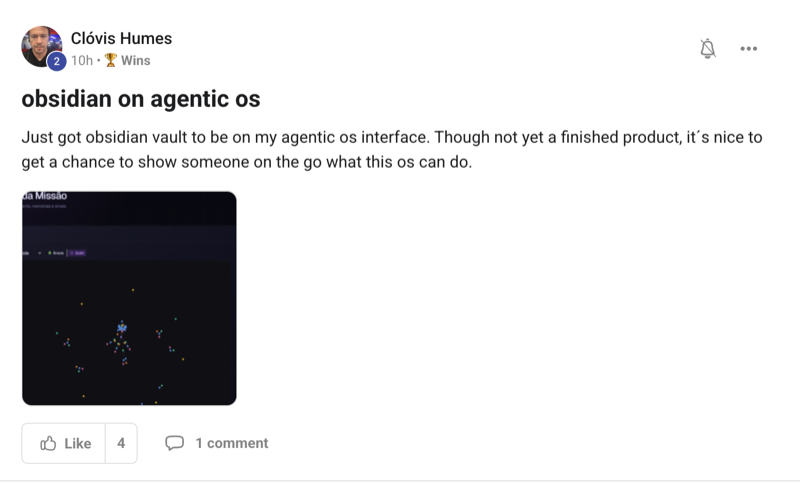
My conversations with Hermes and Hermes Jarvis are linked to my Obsidian memory, which I call the memory galaxy.
Everything I do with Jarvis gets logged there and I can go back to it later.
That's how "what have I been working on this week?" came back with a real answer about thumbnail work rather than a polite guess.
It makes managing everything in one place much easier, and it's the difference between a toy and an assistant.
The Hermes second brain guide walks through connecting it.
The free local version
I've done something similar with free Claude Code, running an agent factory you can speak or type to while it builds live in front of you.
That setup runs Qwen 2.5 Coder with Ollama, so a free local model is doing the work.
When you think about it properly, that's mind-blowing — and local models keep getting better every month.
If budget is the thing stopping you, start there rather than not starting.
Honest limits before you install
Sometimes it doesn't work, and sometimes it isn't smooth.
I improve this system daily and commands still misfire occasionally.
For getting a lot done quickly, I'd point you at Paperclip or a structured agent team instead, because you'll create more and faster.
As a fun party trick with AI that leaves behind real, reusable builds, this is my favourite thing I've built.
Let's be honest though — this is the worst it's ever going to be.
🔥 Want my full Hermes Jarvis setup, ready to install? The Agent OS pack inside the AI Profit Boardroom includes the full video tutorial, the install zip with prompts, and daily new tutorials. You also get four weekly coaching calls where you can share your screen and get help live. → Get the Agent OS here
FAQ
What does a Hermes dashboard command do?
It tells the Hermes agent to build something, recall something from your logs, show a dashboard panel, or open something on your computer. Anything it builds is stored in the builds gallery.
What do I need to run Hermes dashboard commands?
Three things: Hermes agent for the agentic work, ElevenLabs for the voice, and Claude in the background for building and improving the system.
Is Hermes free to use?
Hermes agent itself is open source. Costs come from the models and the voice API. I've also run a similar agent factory on Qwen 2.5 Coder with Ollama, which is free and local.
What is the Hermes wake word?
Mine are Jarvis and Hermes. Saying either switches the listener on and saying it again switches it off.
Can I see everything a Hermes command has built?
Yes. Say "show me everything I've built" and the gallery opens with every previous build.
Do I need to be able to code?
No. I don't code, and I built a habit tracker, a website, a flashcard game and a meditation timer through commands alone.
About Julian
I'm Julian Goldie — AI entrepreneur, SEO expert, and founder of the AI Profit Boardroom (2,800+ members). I help business owners scale with AI agents, automation, and SEO.
- 400K+ YouTube subscribers
- 7-figure AI agency (Goldie Agency)
- Daily training inside the Boardroom
- Author of multiple AI automation playbooks
→ Get my best AI training inside the AI Profit Boardroom
Also On Our Network
- 🌐 Read on bestaiagentcommunity.com
- 🌐 Read on aiprofitboardroom.com
- 🌐 Read on juliangoldieaiautomation.com
- 🌐 Read on aisuccesslabjuliangoldie.com
Related reading
- What is the Hermes Agent OS dashboard? — the full tour.
- Best Hermes agent dashboard — which one to run.
- Agentic OS mission control — agent teams explained.
Install the three parts, learn the six phrases, and your first Hermes dashboard command will be running tonight.
📺 Video notes + links to the tools 👉