Agentic OS mission control took the worst part of running AI agents and made it fast, and the time saving is genuinely silly.
Debugging a broken agent task used to eat an hour of my day.
Now it takes about five minutes.
The reason is simple: I can finally see every step the agent took instead of staring at a bad answer.
Let me show you how that hour-to-five-minutes shift actually works.
The hour you've been wasting
Let me paint the picture, because you've probably lived it.
An agent task fails or comes out weak.
You don't know which step caused it, so you start rebuilding.
You tweak the prompt, rerun the whole thing, wait, and check the new result.
Still off, so you tweak again and rerun again.
An hour later you've maybe fixed it, and you're not even sure what you changed.
That's the hidden tax on running AI agents — the messy middle is invisible, so every fix is a full teardown.
Agentic OS mission control deletes that tax.
How the 5-minute fix actually works
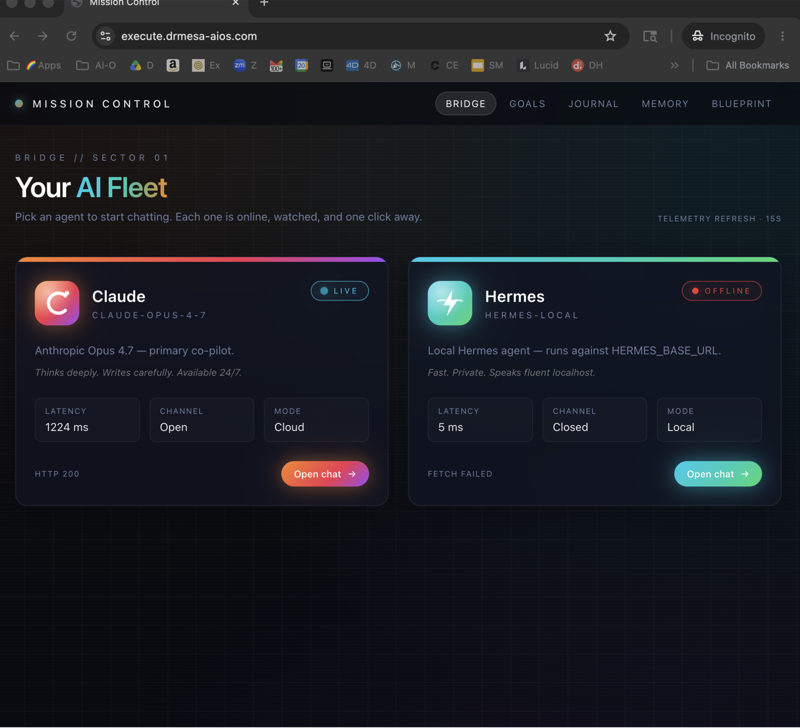
Agentic OS mission control is a dashboard that shows the whole journey your agent took, not just the ending.
A journey is the full path from start to finish, every step.
You see the prompts, the tool calls, the tool results, the failures, the model switches, and the memory it pulled from.
When a task fails, you open the exact failed step.
You see the input that went in.
You see the output that came back.
You see the timing and the result.
So instead of rebuilding the whole automation, you walk straight to the broken step and fix that one thing.
That's the difference between an hour of frustration and a 5-minute repair.
The walkthrough of the wider dashboard lives in my agentic OS command center guide.
🔥 Want to claw back hours every week? Inside the AI Profit Boardroom I share the full agentic OS mission control setup, weekly coaching calls, and 2,800+ members building faster, cleaner automations. → Get access here
Read it backwards to save even more time
Here's the habit that keeps the fix under five minutes.
Don't read every step from the start.
Start at the end where the result landed, then walk backwards until you hit the step that looks off.
Nine times out of ten, the weak link is only one or two steps before the final answer.
You're not reading the whole journey — you're scanning the tail.
That's why it's minutes, not hours.
Once your eye learns to scan backwards, the broken step jumps out at you.
The real time savings in my business
Let me make this concrete with money on the line.
I run a content agent to bring people into the AI Profit Boardroom.
When a draft comes out weak, that used to mean an hour of rebuilding the prompt chain.
Now I open the journey, find the step where it pulled the wrong source, and fix it in minutes.
I run a research agent too, for planning future topics.
When its short list felt off, the journey showed it leaned on stale memory instead of searching fresh.
One look, one fix.
Multiply that across a dozen agent runs a week and the time adds up fast.
That's hours back in my week, every week.
1 hour vs 5 minutes, side by side
Here's the breakdown that made me a believer.
| Step | Old way (the rebuild) | Mission control (the 5-min fix) |
|---|---|---|
| Find the problem | Guess, rerun, repeat | Walk the journey backwards |
| Diagnose | 20-40 minutes | 1-2 minutes |
| Fix | Rewrite whole chain | Edit one step |
| Verify | Full rerun | Targeted rerun |
| Total time | About an hour | About 5 minutes |
Saving model spend too
Time isn't the only thing this saves — it saves money on models.
Agents start on a lighter model for easy stuff and jump to a stronger model when things get harder.
That's smart at the right moment and wasteful at the wrong one.
Mission control shows exactly when each switch happens.
So you can see where the heavy lifting is going and trim the waste.
Good AI systems aren't just powerful, they're efficient — and efficient means cheaper to run.
Keeping skills lean over time
The more your agent works, the more skills it builds.
A skill is a reusable playbook the agent saves so it doesn't start from zero each time.
But you end up with playbooks you forgot about, and some go stale.
Mission control shows you which skills exist and which ones the agent actually uses.
You refresh the stale ones, and your automation gets faster and more reliable instead of slower and messier.
Safe, even on your money-making workflows
The best part is that this is safe to run on the workflows that actually make you money.
Agentic OS mission control is read-only.
It watches what the agent did without ever changing the live session.
It can't start, stop, or interfere with a running agent.
It also redacts secrets like API keys in previews and reports.
And you can export the full journey as clean markdown or JSON with the sensitive stuff already hidden.
So you get speed and safety at the same time.
For scaling this across multiple agents, see my Hermes Agent Swarm guide and the Agent OS Hermes engine breakdown.
🔥 Want the zip + the 30-day roadmap? Inside the AI Profit Boardroom you get the Agent OS zip ready to install and a 30-day roadmap of agentic OS mission control use cases. → Join 2,800+ members here
FAQ: saving time with agentic OS mission control
How does agentic OS mission control save me time?
It shows every step of your agent's journey, so when a task fails you open the exact broken step and fix one thing instead of rebuilding the whole workflow. That typically turns an hour-long fix into about five minutes.
Why was debugging agents so slow before?
Because the middle of an agent run was invisible. With no way to see which step failed, every fix meant tweaking the prompt and rerunning the entire chain, over and over.
What's the fastest way to read a journey map?
Start at the end and walk backwards. The weak link is usually only one or two steps before the final answer, so you scan the tail instead of reading everything.
Does agentic OS mission control save money too?
Yes. It shows when your agent switches between lighter and stronger models, so you can trim wasted model power and lower your running costs.
Is it safe to use on live, revenue-generating agents?
Yes. It's read-only, so it never changes your live session, and it redacts secrets in previews and exports, making it safe for production and client work.
About Julian
I'm Julian Goldie — AI entrepreneur, SEO expert, and founder of the AI Profit Boardroom (2,800+ members). I help business owners scale with AI agents, automation, and SEO.
- 400K+ YouTube subscribers
- 7-figure AI agency (Goldie Agency)
- Daily training inside the Boardroom
- Author of multiple AI automation playbooks
→ Get my best AI training inside the AI Profit Boardroom
Also On Our Network
- 🌐 Read on bestaiagentcommunity.com
- 🌐 Read on aiprofitboardroom.com
- 🌐 Read on juliangoldieaiautomation.com
- 🌐 Read on aisuccesslabjuliangoldie.com
Related reading
- Agentic OS Command Center: The 2026 Dashboard
- Hermes Agent Swarm: Free Multi-Agent Update
- Agent OS Hermes: The Engine Running My 2026 Stack
📺 Video notes + links to the tools 👉
🎥 Learn how I make these videos 👉
🆓 Get a FREE AI Course + Community + 1,000 AI Agents 👉
If your time is worth anything, agentic OS mission control is the upgrade that turns an hour of agent debugging into five minutes.