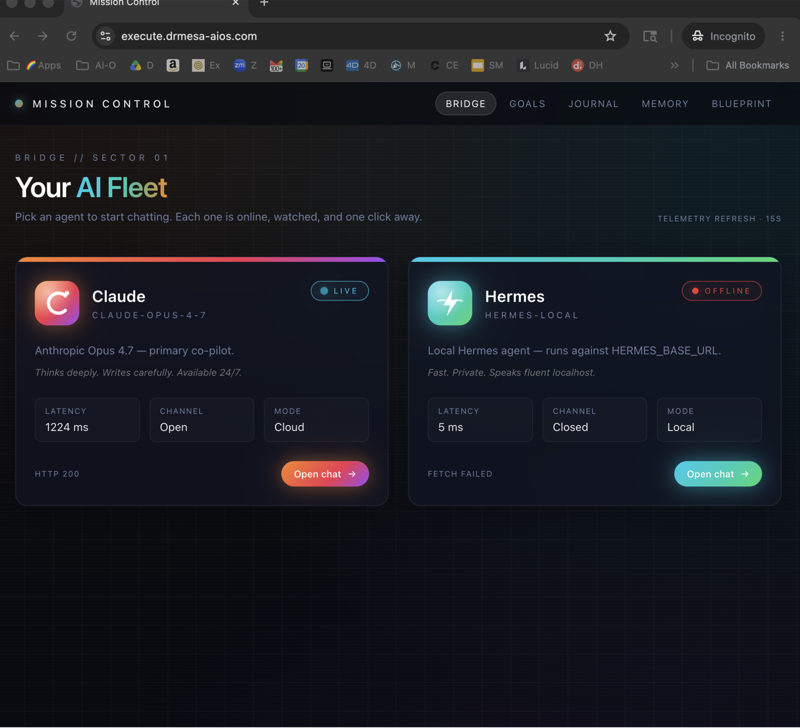
You can now run Hermes Agent with Claude Code subscription — no API key, no second bill — through the official claude-subscription-directsdk plugin that NousResearch shipped on 20 September 2026, which drives the unmodified Claude Code CLI as Hermes' model provider. Every request rides the Claude plan you already pay for, and the whole setup takes a few minutes.
📺 Watch: New Hermes + Claude Plugin Update is AWESOME!
🔥 Get the Agent OS as a free bonus: AI Profit Boardroom members get the full Agent OS zip, prompt libraries, daily tutorials and weekly live coaching calls. → Get inside
That closes a gap that has annoyed Hermes users for months. Claude previously stopped working inside Hermes altogether, and in his 22 September video, Julian Goldie calls the new plugin the fix that brings it back — his own run took about 3 minutes from install to working reply. This page walks the full route: what the plugin is, the 4-step setup, which Claude models you get, what it draws from your subscription, and two honest flags before you connect your account.
If you want the wider map of the Hermes and Claude pairing before the hands-on part, start with the Hermes + Claude overview. This page is the doing-it lane.
Two Doors, Two Bills: The Problem the Plugin Closes
Julian's gym analogy from the video is the cleanest way to see it. You paid for the gym membership — that is your Claude subscription. But the good machines had a card reader bolted on: the moment you wanted Claude working inside an agent like Hermes, you needed a separate API account, metered per token. Same building, two doors, two bills.
So people either paid twice — a monthly Claude subscription plus per-token API charges for agent use — or they left Hermes on other models and watched the Claude door stay shut. Neither felt right, because the capability was already paid for. The claude-subscription-directsdk plugin closes the second door: Hermes drives the official Claude Code CLI, the CLI runs on your logged-in subscription, and the per-token invoice never appears.
What the Plugin Actually Is
The plugin's README lays the facts out plainly. claude-subscription-directsdk is an official-tier catalog plugin published by NousResearch — not a community fork — currently at v0.3.0, marked Experimental, MIT-licensed, and supported on Linux, macOS, and Windows. It landed in the Hermes catalog on 20 September 2026 and was re-pinned to a reviewed commit on 22 September.
The requirements list is short: Hermes Agent 0.21.4 or newer, Python 3.10 or newer, and the official Claude Code CLI installed and logged in. That last item is the entire trick. The plugin carries no credentials of its own — no key file, no token store, nothing to rotate or leak. Every request flows through the claude CLI and whatever account it is signed into. For the transport-level detail of how Hermes drives that CLI under the hood, the CLI layer deep-dive has it; in practice, the plugin treats Claude Code as a model provider and leaves the binary completely unmodified.
Releases like this plugin get field-tested fast inside AI Profit Boardroom — 3,000+ members running Hermes, Claude, and full agent stacks, posting working configs and fixes within days of a drop. Worth keeping open in another tab if you hit an edge case.
📺 Watch: Claude Code for FREE + Hermes Agent OS!
Hermes Agent With Claude Code Subscription: The 4-Step Setup
Julian's on-camera setup took about 3 minutes, against the roughly 20 the old workaround cost him. Four steps, in order.
- Install and log in to Claude Code. If you already use Claude Code daily, skip ahead. Otherwise install the official CLI with npm install -g @anthropic-ai/claude-code, then run claude auth login and sign in with your subscription account. The plugin inherits whatever account this CLI is logged into, so make sure it is the one you intend to use.
- Update Hermes Agent to 0.21.4 or newer. The plugin's README sets 0.21.4 as the floor, alongside Python 3.10 or newer. An older Hermes build simply will not surface the provider.
- Install the plugin. Run hermes plugins install claude-subscription-directsdk to pull the commit-pinned, reviewed build from the official catalog. The README also documents installing straight from the NousResearch GitHub repository, or cloning the repository to disk and pointing Hermes at the local folder — but the catalog route is the one that stays pinned and reviewed, so treat the other two as developer paths.
- Pick the provider and create a profile. Run hermes model and choose Claude Subscription DirectSDK (Experimental) from the list. Julian then ran hermes profile create claude opus to name the brain — his profile shows up as Claude Opus — typed a test message, and it came back working. That reply is your whole verification step.
If sign-in loops, expired sessions, or a wrong-account surprise bite you at step one, the auth deep-dive untangles those mechanics one by one — this page stays on the happy path.
Which Claude Models You Get
The plugin's README pins five Claude routes, each reachable by a short name inside a Hermes profile.
| Model | Context | Short name | Plan note |
|---|---|---|---|
| Sonnet 5 | 1M | sonnet | No special note in the README |
| Haiku 4.5 | 200K | haiku | No special note in the README |
| Opus 5 | 1M | opus | 1M context carries a usage-credits note on Pro |
| Opus 4.8 | 1M | — | Same Opus 1M note applies on Pro |
| Fable 5.1 | 1M | fable | Pro: usage credits from the first request. Max: included up to 50% of weekly limits |
The plan rule matters more than the spec column. Per the plugin's README, citing Anthropic's documented rule: on a Pro subscription, Fable models bill to pay-as-you-go usage credits from the very first request — they sit outside your included limits — while Max plans include Fable up to 50% of weekly limits. The Opus 1M context carries a similar usage-credits note on Pro. Julian's cost note in the video says the same thing in plain English: he would not run this with Fable 5 unless you are okay with the token cost. For everyday Hermes work, the sonnet and haiku routes are where most subscriptions will live.
For how these Claude models actually compare on real agent tasks, see Goldie Bench.
📺 Watch: FREE Claude Code + Hermes Agent is INSANE 🤯
What It Draws From Your Subscription
The plugin's README publishes measured metering numbers rather than guesses — a 9 September test on a Pro plan — and three of them are worth knowing before your first long Hermes session.
- The rate. This provider draws subscription usage at exactly the claude -p and Agent SDK rate — about 8.9 points per list-dollar in the README's test.
- The comparison. Interactive Claude Code is metered at roughly 0.58x that rate, so plan for about 60% of the interactive TUI's throughput per 5-hour window when the same subscription powers Hermes instead.
- The offset. On identical coding tasks, Hermes sent about 0.6x the tokens native Claude Code did, which claws a meaningful chunk of that difference back.
Net position for a subscription holder: your Claude plan stretches further inside the interactive app than inside Hermes, but Hermes' lighter token footprint narrows the gap — and none of it is a second bill. It is the same allowance, spent through a different door.
If you want those numbers turned into a plan for your actual workload — which agents, which Claude models, how many hours a day — book a free strategy session and map it out before you spend a week finding the limits by trial and error.
What Hermes Keeps Doing
The plugin swaps nothing except the model door. Hermes keeps its own agent loop, its own tools, its own approvals, and its own memory and compaction — Claude is the brain answering inside that loop, not a replacement for it. Julian's framing in the video: Hermes still reads files, runs commands, uses the web, and checks its own work, exactly as before.
That is why the plugin drops so cleanly into his stack. Julian runs it inside his Agent OS, and his existing workflows — Hermes Oracle, Muse, Astros — picked up Claude as a provider without being rebuilt. If you run Hermes inside an Agent OS setup too, Hermes + Agent OS shows how the two layers fit together, and the Agent OS guide covers the full system if you are starting from zero.
Before You Connect: Two Flags
Two things deserve a slow read before you point this plugin at your Claude account. Neither is a panic button. Both matter.
Flag one — Nous itself calls the plugin Experimental. The plugin's README carries the Experimental label, and its own disclosure is direct: every turn is billed against your Claude subscription's Agent SDK allowance, and the provider inherits whatever account the claude CLI is logged into. The costs it reports in-session are list-price equivalents, not verified subscription charges, so treat them as estimates rather than receipts.
Flag two — the terms question. Community members in the comments under Julian's video have publicly asked whether routing a subscription through a third-party harness sits inside Anthropic's current terms. Julian's own answer there: check Anthropic's current Terms of Service and your plan documentation before connecting your account. The README's engineering posture is careful — it drives the unmodified official CLI and never opens or copies your credentials — but careful engineering is not a terms ruling, in either direction. That verification is yours to do against Anthropic's current docs.
Hermes and Claude Subscription FAQ
Do I need an API key?
No. The claude-subscription-directsdk plugin holds no credentials at all — per the plugin's README, everything routes through the official Claude Code CLI and the subscription account you signed in with via claude auth login. No API key, no per-token bill, no second account to manage.
Which Claude plan works?
Any plan the Claude Code CLI will log into works with the plugin. The practical split shows up on Fable: per the README, citing Anthropic's documented rule, Pro plans bill Fable models to pay-as-you-go usage credits from the first request, while Max plans include them up to 50% of weekly limits. Sonnet 5 and Haiku 4.5 carry no special note, and the Opus 1M context flags usage credits on Pro.
Is this official?
On the Hermes side, yes — the plugin ships at official tier in the Hermes catalog, published by NousResearch, at v0.3.0, MIT-licensed, commit-pinned and reviewed. On the Anthropic side, it is a third-party harness driving the unmodified Claude Code CLI, which is exactly why the terms check in the flags section above is worth ten minutes before you connect.
Get It Running, Then Put It to Work
Three minutes of setup turns the Claude subscription you already pay for into the brain of a full Hermes agent — no API key, no second bill, five Claude models on tap. The difference between people who read about plugins like this and people who profit from them is the system wrapped around the agent.
Two ways to shortcut that. Join AI Profit Boardroom — 3,000+ members shipping Hermes and Claude workflows daily, with the configs, prompts, and fixes already posted — at $69/mo locked in (normally $110). Or grab a free strategy session and get a straight answer on where a Hermes agent running on your Claude subscription fits into your business.