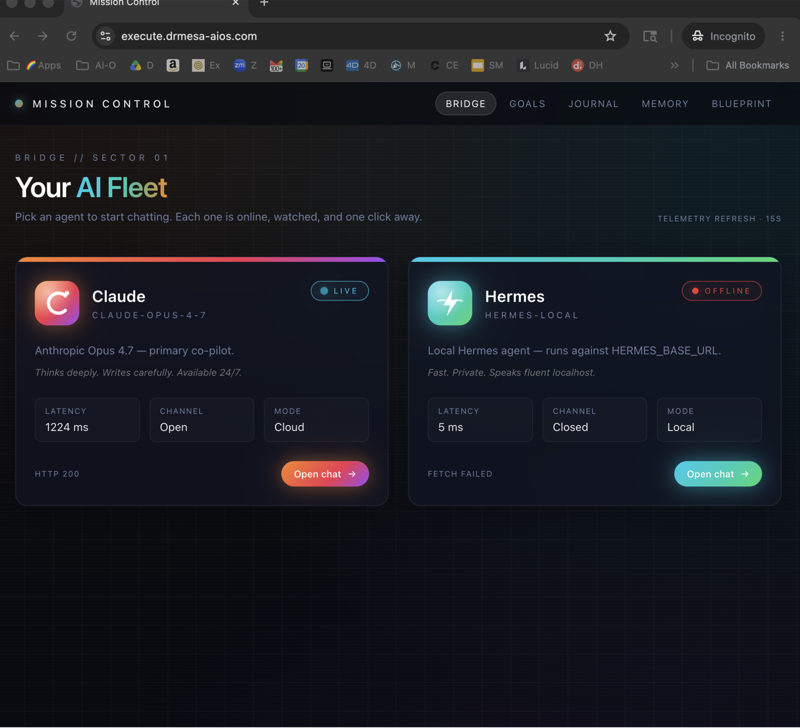
The Claude Desktop Ollama integration is live: according to the announcement on the Ollama blog dated 25 August 2026, you can now configure Claude Desktop to work with Ollama as a third-party gateway provider, which means open models — running locally on your own machine or on Ollama's cloud — can now power the Claude Desktop app you already use. That is the whole story in one sentence, and it is a bigger deal than it sounds. Until now, Claude Desktop meant Anthropic models, full stop. As of this week, the same familiar interface can run open models too, and you can swap back to your existing Claude setup whenever you like.
📺 Watch: Qwen 3.8 27B is NOW on Ollama... This is CRAZY
🔥 Get the Agent OS as a free bonus: AI Profit Boardroom members get the full Agent OS zip, prompt libraries, daily tutorials and weekly live coaching calls. → Get inside
I have been running open models through Ollama alongside my paid AI subscriptions for months, and the pattern I keep coming back to is simple: use the frontier model where quality genuinely pays, and push everything else to models that cost nothing to run. This integration makes that pattern dramatically easier to live with day to day, because both worlds now sit inside one app. Below is what the announcement actually says, how the connection works, and how I would use it if you are building an AI-powered business rather than just playing with new toys.
What the Claude Desktop Ollama Integration Actually Does
Per the official announcement, the integration lets developers configure Claude Desktop to work seamlessly with Ollama as a third-party gateway. In practice, Ollama sits between Claude Desktop and the model, and once connected you can choose any model within Ollama — both local models running directly on your computer and models on Ollama's cloud. The announcement frames the split sensibly: use open models in Claude for everyday work, and use cloud models for larger coding and research tasks that outgrow your hardware.
Three details from the announcement matter for anyone doing this for business reasons rather than curiosity. First, this is a toggle, not a migration — you turn Claude on inside Ollama and the gateway is configured for you, and turning it off restores your previous setup. Second, you keep access to Anthropic models: the FAQ confirms you can switch between Anthropic models and Ollama by toggling the feature inside Ollama. Third, local models are supported — the FAQ says you can go to the Settings page and configure a local model, which is exactly what you want if your machine can carry a decent open model.
How to Connect Claude Desktop to Ollama
The setup steps, straight from the release notes, are refreshingly short. Download Ollama, open it, and select Claude. Turn Claude on, and Ollama configures the third-party gateway for you — that is genuinely the entire process. While connected, you pick whichever model you want from within Ollama, local or cloud. When you want your old configuration back, you turn Claude off in Ollama and everything returns to how it was.
If you have already got a local model library, this will feel familiar. If you have not, my guide to local model setup covers the fundamentals that apply here too: pick a model your RAM can actually hold, quantised versions where sensible, and do not judge local models by the first thirty seconds of use. And if you are wondering which open models are worth your disk space in the first place, I keep a running shortlist in my guide to the best Ollama models for agent work — the same logic applies whether the model is talking to an agent or to Claude Desktop.
If you want my full local-AI stack — which models I run through Ollama, what I keep on paid plans, and the exact workflows that pay for themselves — I walk through all of it inside AI Profit Boardroom → Steal my local AI setup
📺 Watch: NEW Claude Update is AMAZING
Local Models or Ollama Cloud: Which Should You Run in Claude Desktop?
The announcement draws the line clearly: open models on your computer for day-to-day use, cloud models for the larger coding and research tasks. My rule of thumb maps onto that split. If the task is high-volume and low-stakes — summarising, drafting, classifying, reformatting, first-pass research — a local open model through this integration costs you nothing per token and keeps everything on your machine. If the task is genuinely hard — long agentic coding sessions, complex analysis — either flip to a bigger model on Ollama's cloud or toggle back to Anthropic models and pay for the quality.
This is the same decision framework baked into the Agent OS, the agent operating system I built and test in my own business every day: route work to the cheapest model that clears the quality bar, and escalate only when the output tells you to. Model routing is a profit lever, not a technical detail — often the difference between an AI stack that costs hundreds a month and one that costs pocket change.
Privacy and Data: What the Claude Desktop Ollama FAQ Says
The privacy section of the announcement is unusually direct, so it is worth quoting the substance. Asked whether prompts or data are sent to Anthropic or Ollama, the FAQ answer is no — telemetry is disabled by default, and Ollama states it has a strict Zero Data Retention policy across all of its models and services, whether accessed through the cloud or on your local machine. For anyone handling client data, that combination — local execution where you want it, zero retention where you use the cloud — is the practical takeaway. As always, read the current policy yourself before you put anything sensitive through any tool; policies are living documents and the announcement reflects the position at launch.
📺 Watch: Run Claude Code for Free : Heres How
Why This Matters If You Make Money With AI
Here is my honest read on why this release matters more than the average integration news. The single biggest objection I hear from business owners about going deep on AI is cost anxiety — the fear of building your operation on top of subscriptions and metered APIs that you do not control. Open models answer that objection, but until now they mostly lived in developer tools. Putting them inside Claude Desktop, an interface non-developers already use, closes that gap in a way that terminal-based tooling never will.
It also fits a broader pattern I have covered before: the stack is going hybrid. I run agents locally against Ollama — my walkthrough on running a Hermes agent on local Ollama models shows that exact build — and the sites you are reading now are produced by workflows that mix free local models with paid frontier ones. On Goldie Bench, my own benchmark that I run against every notable model release, the gap between good open models and frontier models keeps narrowing on routine business tasks, which is exactly why a toggle that lets you use both from one app is worth setting up this week rather than eventually.
If you want to go further down this road, the natural next step after connecting Claude Desktop is wiring the same Ollama install into an agent — my Hermes with Ollama setup guide covers that, and it shares the model library with this integration, so nothing is downloaded twice. Same models, two front doors: a chat app when you want to drive, an agent when you want it done for you. That said, if your main interest is pairing a desktop AI app with a specific model family, my comparison of Claude Code Desktop with DeepSeek covers the other popular route — that page is about pairing Anthropic's coding desktop app with DeepSeek models, whereas this one is about the new official Ollama gateway for the Claude Desktop chat app.
Claude Desktop Ollama: Quick Reference
| Question | Answer, per the official announcement |
|---|---|
| What shipped? | Claude Desktop can be configured to work with Ollama as a third-party gateway provider |
| When? | Announced 25 August 2026 on the Ollama blog |
| How do you connect it? | Open Ollama, select Claude, turn Claude on — the gateway is configured for you |
| Which models can you use? | Any model within Ollama, both local and on Ollama's cloud |
| Can you still use Anthropic models? | Yes — toggle the feature inside Ollama to switch between them |
| Local models supported? | Yes — configure a local model from the Settings page |
| Is data sent to Anthropic or Ollama? | No — telemetry is disabled by default, with a strict Zero Data Retention policy |
| How do you undo it? | Turn Claude off in Ollama to restore your previous setup |
Claude Desktop Ollama FAQs
What is the Claude Desktop Ollama integration?
It is official support, announced on the Ollama blog on 25 August 2026, for using Ollama as a third-party gateway provider inside Claude Desktop — so open models, local or on Ollama's cloud, can be used from the Claude Desktop app, with an easy toggle back to your existing Claude setup.
Is the Claude Desktop Ollama connection free to use?
Ollama itself is a free download and local models run on your own hardware. Cloud models and Anthropic models follow their own pricing. The smart play is routing: free local models for routine work, paid models where quality genuinely earns its keep.
Do I lose access to Anthropic models when connected to Ollama?
No. According to the announcement's FAQ, you can switch between Anthropic models and Ollama by toggling the feature inside Ollama, and turning it off restores your previous setup entirely.
Does my data get sent to Anthropic or Ollama?
The announcement says no — telemetry is disabled by default and Ollama operates a strict Zero Data Retention policy across its models and services, cloud or local.
Should I use local models or Ollama's cloud models in Claude Desktop?
The announcement itself suggests the split: open models locally for everyday use, cloud models for larger coding and research tasks. Match the model to the stakes of the task and you will rarely get it wrong.
Verdict: Set the Toggle Up This Week
The Claude Desktop Ollama integration is one of those releases where the engineering is small and the implications are not. One toggle turns the most polished desktop AI app into a front end for the entire open-model ecosystem — reversibly, with a zero-retention privacy stance and no new interface to learn. If you have been waiting for a low-friction way to start using open models in real work, this is the on-ramp, and it took me longer to write this paragraph than the setup takes.
Want the shortcut? Inside AI Profit Boardroom I share my complete model-routing playbook — which tasks go local, which go frontier, and the agent workflows that turn the savings into output → Get my hybrid AI stack