The orca ai agent setup is the closest thing I have used to commanding a small development team rather than chatting with one assistant. Orca is a free, open-source agentic development environment built for running fleets of parallel agents — several of them, on the same project, at the same time. This is a look at what it can actually do: which agents you can run, what the skills unlock, how the automations and mobile control work, and who it genuinely suits.
📺 Watch: Orca: FREE AI Coding Agent (Open Source!)
🔥 Get the Agent OS as a free bonus: AI Profit Boardroom members get the full Agent OS zip, prompt libraries, daily tutorials and weekly live coaching calls. → Get inside
Fleets, Not A Single Assistant
Most AI coding tools hand you one helper in one window. You ask, it answers, you ask again. Orca is built on a different assumption: that a real project has several jobs happening at once, so it should have several agents at once.
You split the terminal right or down and each pane becomes another agent working the same codebase. In practice that means one agent building a feature while another reviews, or two different models attacking the same brief so you can compare their output side by side. Once you have worked that way, a single-agent window feels like a bottleneck.
Which Agents The Orca AI Agent Environment Runs
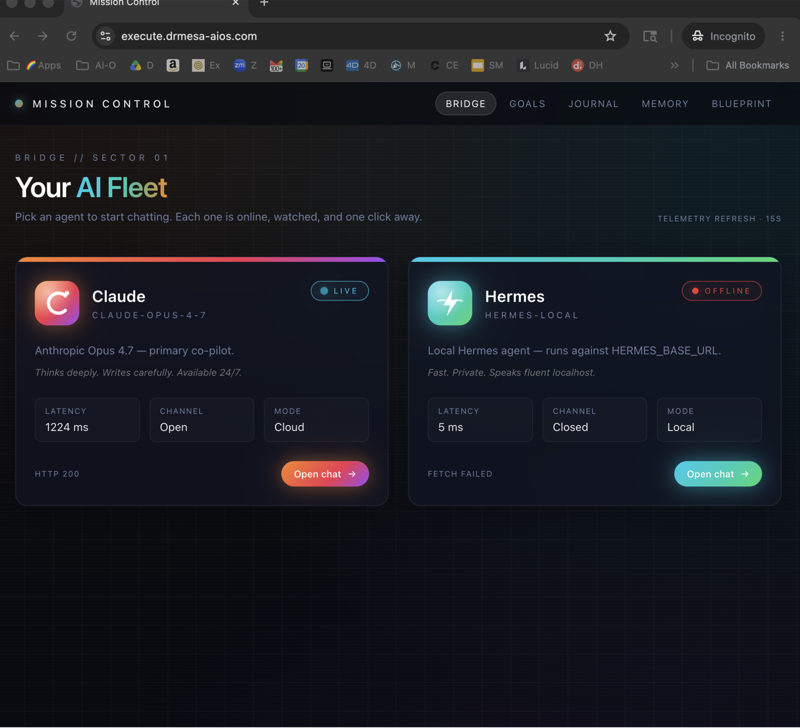
Orca is deliberately agnostic about whose agent you use. You can run Claude Code, Codex, Hermes, Kimi, OpenClaw and Antigravity, adding, enabling or disabling them in the settings. That flexibility is the real feature — you are not marrying one vendor, and if one runs out of tokens you switch panes and keep going.
It also means the cost question has a good answer. Already paying for Codex, Claude Code or OpenClaw? Plug them in and Orca adds nothing to the bill. No subscriptions at all? Run Hermes with a free API such as Ling flash and the whole stack is genuinely free.
On that point — in one of my own runs I gave the same brief to Claude Code and to free Ling 3.0, and the free output looked slightly nicer that time. That is a single hands-on comparison of the sort I do in my Goldie Bench testing, not a definitive ranking. But it is a useful reminder that the free lane is not the consolation prize.
What The Orca AI Agent Can Actually Do
| Capability | What it means in practice |
|---|---|
| Parallel agents | Split terminals so several agents build the same project simultaneously |
| Agent choice | Claude Code, Codex, Hermes, Kimi, OpenClaw, Antigravity — enable or disable at will |
| Live preview | Render your project from a localhost URL in a browser tab inside Orca |
| Element select | Send one exact page element to an agent for targeted feedback |
| Annotations | Mark up the page with commands or questions, queue them, send in one batch |
| Mobile emulation | Preview app builds via Xcode or an Android Studio virtual device |
| Orca Mobile | Scan a QR code and drive your terminals and projects from your phone |
| Automations | Schedule recurring agent work to run in the background |
| Computer use | Agents control any app on your computer once the skill is installed |
| Orchestration | Coordinate agents rather than running them in isolation |
The skills are the interesting part
Two optional skills change what the agents are capable of, and both install from a terminal prompt in seconds. Computer use lets an agent control any application on your machine, so its reach extends past the code editor. Orchestration lets agents coordinate rather than each ploughing its own furrow. There is voice support too, although I do not personally use it.
Automations turn it into background work
The automation panel is where this stops being a coding tool and starts being a small workforce. You schedule an agent task on a repeating basis — improve the project a little every day, or research a topic and draft a post about it — and it runs without you. The honest caveat: your computer has to be running for scheduled work to fire, so this is background automation on your machine rather than in the cloud.
Mobile control is more useful than it sounds
Orca Mobile connects by QR code and lets you run your terminals and projects from your phone. I have not stress-tested it myself. But having tried remote coding through other tools and come away unimpressed, the idea of steering several agents across several projects from a phone — from the gym, from a train — is a genuinely better proposition than what I have used before.
If you want to make money running fleets of AI agents, check out the AI Profit Boardroom — the ready-made agent systems, daily tutorials and live coaching are all inside. → Get the agent fleet playbook here
Who It Is For
- Anyone building software with AI who is tired of one-agent-at-a-time and wants parallel work on one project.
- People with existing subscriptions — Codex, Claude Code, OpenClaw — who want more out of what they already pay for.
- People on a zero budget, because the free agent plus free API route is real, not a trial.
- Builders who think visually, thanks to element select and page annotation instead of describing changes in prose.
- Anyone who wants to compare models honestly by running two of them on the same brief in adjacent panes.
Who it is not for: if you do not use any of the supported coding agents and have no interest in building software, this is not your tool. It is a development environment first.
📺 Watch: Jack Dorsey's Buzz DESTROYS Hermes Agent?
Orca And An Agent OS: Different Jobs
It is worth being clear about where Orca stops. It is superb at running coding agents in parallel. It is not designed to run your whole business.
That is the role of an Agent OS — the agentic operating system where Hermes runs with shared memory, a mission-control dashboard and skills for content, SEO, research and publishing. Orca builds the product; the Agent OS runs the machine around it: the content, the outreach, the reporting, the follow-through.
Used together they cover both halves. If you want the Agent OS side built for you rather than assembled by hand, that is exactly what I teach inside the AI Profit Boardroom.
📺 Watch: How to Build Agent OS - FREE Course!
How I Actually Use A Fleet
Fleets sound impressive and then people open four terminals and freeze. So here is the simple way to divide the work, which is how I use it in practice.
- Pane one — the builder. Your strongest agent takes the main brief and writes the bulk of the project. Everything else supports this one.
- Pane two — the fixer. A second agent takes the small stuff: the annotations you queued from the preview, copy tweaks, spacing, the details that would interrupt the builder's flow.
- Pane three — the second opinion. Give a different model the same brief as the builder, then compare. This is where you find out that the free option sometimes wins.
- Pane four — the researcher. Something slower and unglamorous: checking references, drafting documentation, preparing the next task while the others build.
The mistake is giving all four panes the same instruction and hoping for magic. Agents are like people: they are useful when they have distinct jobs and a clear brief, and chaotic when they all reach for the same file. Start with two panes, get comfortable with the rhythm, then add more.
Being Honest About The Limits
A few things are worth knowing before you expect too much. Scheduled automations only run while your computer is on, so this is background work on your machine rather than a cloud service. The environment is only as good as the agents you plug into it — Orca does not make a weak model strong. Orca Mobile is promising but I have not properly tested it yet, so treat my enthusiasm there as interest rather than a verdict. And the parallel-agent workflow takes a little getting used to; the first session can feel busy before it feels fast.
None of that is a reason to skip it. It is free, it is open source, and the ceiling is high. Just go in with the right expectations.
Frequently Asked Questions
How many agents can the Orca AI agent environment run at once?
Split the terminal right and down and you can comfortably have several agents — four in my own use — working the same project simultaneously.
Does it cost anything?
No. Orca is free and open source. You either connect subscriptions you already have, or run a free agent with a free API.
Can agents control other apps on my computer?
Yes, if you install the computer use skill. It takes seconds from the terminal and lets agents drive any app on your machine.
Will scheduled automations run when my computer is off?
No. Your machine needs to be running for scheduled tasks to fire.
Is it better than using one agent?
For anything beyond a quick fix, running several agents in parallel and comparing their output is faster and gives you more choice. For a one-line change, a single agent is fine.
The Bottom Line
The orca ai agent environment gives you something rare: a free, open-source place to run a fleet of coding agents together, preview their work live, correct it by pointing at it, and schedule it to keep going in the background. Bring your own agents, run it free if you want to, and pair it with an Agent OS for everything that happens outside the codebase.