Hermes learn — the learn command — is the update that lets Hermes learn from anything you show it and keep it forever as a reusable skill. Show it a blog post URL, a document, a PDF, a folder of code, notes you paste in, or a job the agent has just finished, and it distils that source into a clean, verifiable skill saved for every future session. I call it the learn anything engine, and I think it is the most important thing Hermes has shipped, because it kills the most tedious part of working with an agent: explaining yourself twice.
📺 Watch: Learn Anything Engine for Hermes AgentOS
🔥 Get the Agent OS as a free bonus: AI Profit Boardroom members get the full Agent OS zip, prompt libraries, daily tutorials and weekly live coaching calls. → Get inside
One quick signpost before we start. This page is about the agent doing the learning. If you actually meant learning Hermes yourself — you, the human, getting up to speed with the system — that walkthrough lives at learn the Hermes agent instead. Stay here if you want the overview of the update itself: what it learns from, what happened in my live demo, why it matters, and how to switch it on in about five minutes.
What the Learn Command Can Learn From
The list of valid sources is deliberately wide. Type /learn, point it at one of these, and let it work:
- A blog post URL. Any page that teaches a method becomes a skill the agent can actually apply.
- A document. Your checklists, briefs and process notes stop living in a folder nobody opens.
- PDFs. Hermes already reads these natively — my Hermes PDF reader guide covers that side — and the learn command turns the useful substance into something reusable.
- A folder of code. Point it at a project and it learns how the thing works.
- Notes you paste. Rough bullet points are enough. It tidies them into a proper recipe.
- A job the agent just did. My favourite. Finish a task once, run /learn, and the workflow gets captured while it is still warm.
Whatever the source, the output is the same: a skill.md markdown file — a verifiable, reusable skill the agent carries into future sessions.
The Live Demo: I Taught It My Own Guide
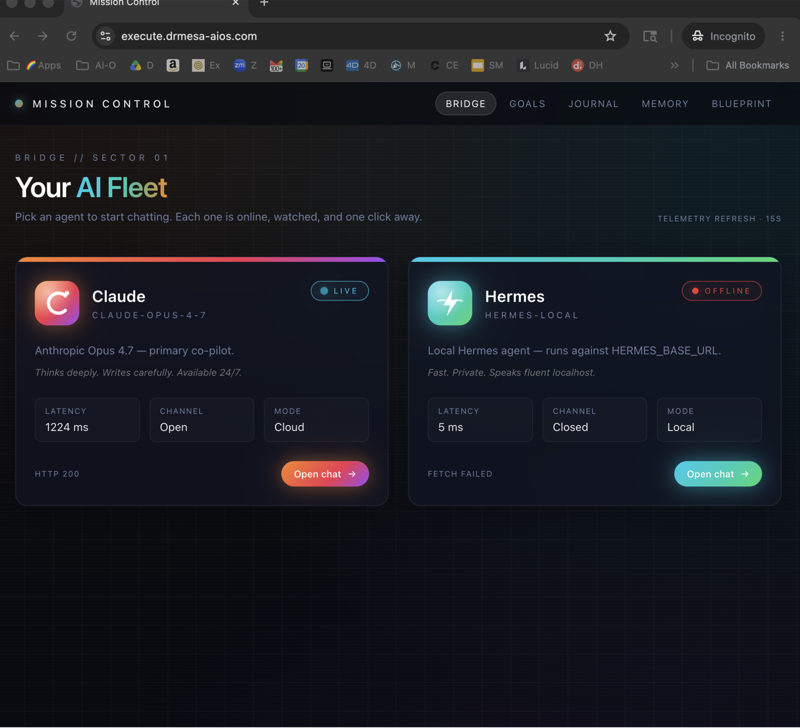
When I demoed this live, I typed /learn plus the URL of my own Agent OS guide. Hermes read the page, summarised what the system actually is — the dashboard, the six pillars, the surfaces, the setup path — and saved it all as a skill. First time, no fuss, no reformatting on my part.
Loading a skill back is /skill plus the skill name. But the part that surprises people is that skills also auto-load when related terms come up in conversation. Mine loads whenever agent OS, mission control or memory galaxy get mentioned — I never have to remember it exists. The knowledge simply turns up when the topic does.
Quick pause: I share the skills I have taught Hermes, plus the workflows behind them, inside the AI Profit Lab community. If you would rather start from working examples than a blank page, that is the place to go.
Why Learn Changes the Way You Work
The old pain was constant, and if you have used an agent for real work you already know it. Every session started with re-explaining how you do things. The agent would nail a workflow, then forget the recipe the moment you were done. Walk it through your process today, open a fresh session tomorrow, walk it through the same process again. You were the only one who remembered how your workflows run, which made you the bottleneck in your own system.
The pitch for Hermes learn is one sentence: show it once, say one word, and it writes itself a clean reusable recipe, keeps it, and next time you just say do the thing. It builds on the same idea as the Hermes memory system — the agent should carry things forward instead of starting cold every single time.
📺 Watch: Hermes AI Just Learned to Read Books
The Five Steps of the Learn Anything Engine
When I explain the update to people, it comes down to five steps:
- It learns from anything. URLs, documents, PDFs, folders of code, pasted notes, jobs it has just finished.
- Teach it once and it keeps it forever. No expiry date, no re-explaining next week.
- It writes its own recipe. You never sit down to document the process — the agent documents it for you.
- It loads only when needed. Skills stay out of the way until the relevant topic appears.
- It works everywhere. One learned skill follows you across every surface Hermes runs on.
How /learn Differs From Downloaded Skills and MCP Servers
Downloaded skill packs and MCP servers are bolt-on tools someone else built. They are useful, and I run plenty of them, but they are generic by definition — a thousand other people installed the identical thing this week.
/learn captures how you do things. Your steps, your order, your quality bar, your edge cases. You cannot download that anywhere, because nobody else has it. That is the difference between adding a tool and teaching a colleague, and it is why I treat this update as its own category rather than another item on the integrations list.
Setting Up Hermes Learn in About Five Minutes
Setup is genuinely short. Run hermes update to pull the command in, point /learn at a source, let it write the skill, then approve the save. That last step depends on the approval gate: with the gate on, the file only saves after you say yes. I run without the gate, which is why my skills save instantly in demos.
Three tips from my own use. First, a clear, specific source gets a better skill — one good guide beats a vague pile of links. Second, you can route /learn to a stronger model for tricky jobs. Third, you do not need a monster model for everyday captures: a free local model wrote a skill in about 25 seconds in my Goldie Bench testing.
This hub stays at the overview level on purpose. For exact usage, phrasing and worked examples, the dedicated /learn command guide is the page to read next.
What If It Learns the Wrong Thing?
Bad skills are not scary, and this is the part people overthink. You see the file before it saves. It is just a markdown note. If one line is off, edit the line. If the whole thing misses, delete it or re-run /learn with a clearer source. Nothing is locked in, and a wrong skill cannot break anything else in your setup.
If you want to understand what a good file looks like line by line, the skill.md deep dive takes one apart properly.
Skills are shareable too. Publish yours, install other people's with one command — I share mine inside my community. And if you want to see finished skills doing real work, my Hermes SEO skills post walks through the ones I use for content.
📺 Watch: Hermes3D Is INSANE: AI Agents Now Have a 3D Office
The Mindset Blocks Around Letting Your Agent Learn
Three objections come up every time I show this, so let me deal with them directly.
"Teaching an agent means writing code." It does not. One word and plain English is the whole interface. If you can explain a task to a colleague, you can teach it to Hermes.
"My agent forgets everything, so why bother?" That is exactly the problem this fixes. The agent stops being a goldfish and starts building muscle memory. The forgetting was the reason to want this, not the reason to skip it.
"I'll wait until the tools are perfect." An agent that learns compounds. Every skill you teach it stays taught, so waiting does not keep you safe — it widens the gap between you and the people already teaching theirs.
One Learned Skill, Every Surface
The update works everywhere Hermes runs: the dashboard chat, the terminal, voice through Hermes Jarvis, and messaging. Teach it a skill at your desk in the morning and use the same skill by voice in the afternoon — my Hermes voice agent guide shows what the hands-free side looks like. Fire the same skill from messaging when you are away from the machine. One learned skill, every surface, nothing copied between them.
What You Get From Each Source Type
Here is the shorthand I give people who ask what /learn actually produces:
| Source type | What you get |
|---|---|
| Blog post URL | The method the post teaches, distilled into a skill the agent can apply |
| Document or pasted notes | Your process rewritten as a clean step-by-step recipe |
| PDFs | The useful substance captured as a reusable reference skill |
| Folder of code | A skill describing how the project works |
| A job the agent just did | A repeatable workflow it can run again on request |
Hermes Learn FAQ
Do I need to write code to teach Hermes something?
No. You type /learn, point it at a source, and speak plain English. The agent writes the skill itself — that is the whole point of the engine.
Where do learned skills get saved?
Each one is saved as a skill.md markdown file and kept for future sessions. It is readable, editable and deletable like any other note on your machine.
How do I load a skill once it is saved?
Type /skill plus the skill name, or let auto-loading handle it. Skills surface on their own when related terms come up, the way mine does whenever mission control or memory galaxy get mentioned.
Can I share learned skills with other people?
Yes. Publish yours, install someone else's with one command. I share the ones I have built inside my community, and swapping skills is quickly becoming my favourite part of it.
What happens if it learns something wrong?
You catch it at the approval step, edit the markdown, delete the file, or re-run /learn with a clearer source. A wrong skill cannot break anything else, so the cost of a miss is close to zero.
My Verdict on the Learn Anything Update
Most updates give an agent a new trick. This one changes its trajectory, because a system that keeps what it learns gets more useful every week you use it. Teach it once, keep it forever, say one word next time — that is the whole promise of Hermes learn, and in my use it has held up.
If you want the shortcut, my learned skills, prompts and workflows are all inside the AI Profit Lab community. Join us, grab what I have already taught my agent, and start teaching yours.